
Why Waterproof Cable Joints Are Becoming Standard in Solar Projects






 2026-10-19 15:41:55
View:389
Solar installations face some of the harshest field conditions imaginable — relentless UV exposure, soil moisture, temperature swings, and mechanical stress. A reliable cable waterproof joint is no longer optional in these environments; it is a technical necessity. Across utility-scale solar farms, rooftop commercial arrays, and ground-mounted residential systems, waterproof cable joints now serve as the baseline protection standard for branch connections and underground routing. Data from the International Renewable Energy Agency (IRENA) shows that electrical connection failures account for nearly 30% of solar system downtime, making sealing quality a direct factor in project ROI.


Understanding Waterproof Cable Joints in Solar Projects
What They Are and How They Work
A cable waterproof joint is a sealed electrical link that keeps the wire connected and keeps water, dust, and other contaminants from getting into the joint. These joints are different from basic terminal blocks or open splices because they use pressure-rated closing materials, like silicone, EPDM rubber, or special gel compounds, that squeeze around the wire insulation to make a tight barrier. In solar applications, they keep conductors safe that run through conduit trenches, cable trays, and direct-buried paths where water is always a risk.
Common Types Used in Solar Installations
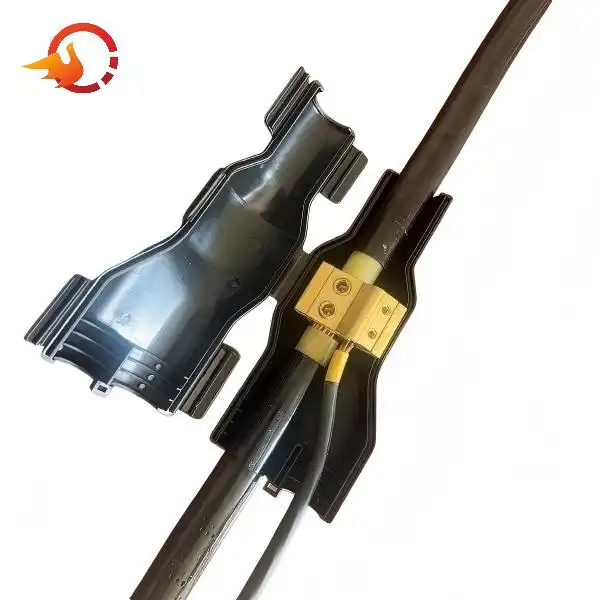
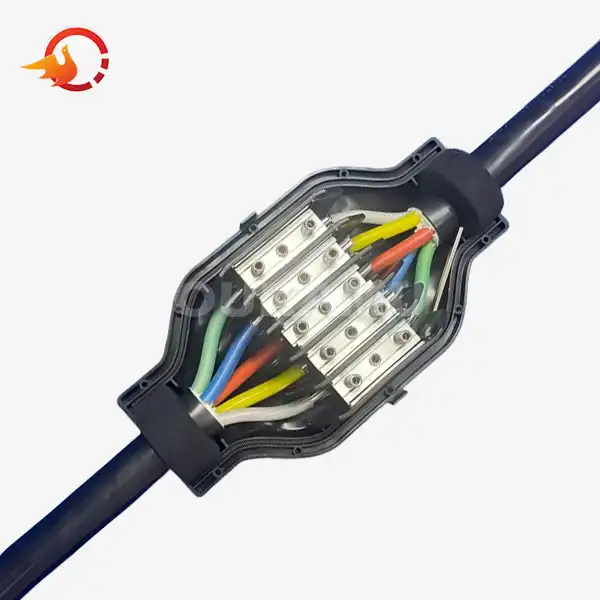
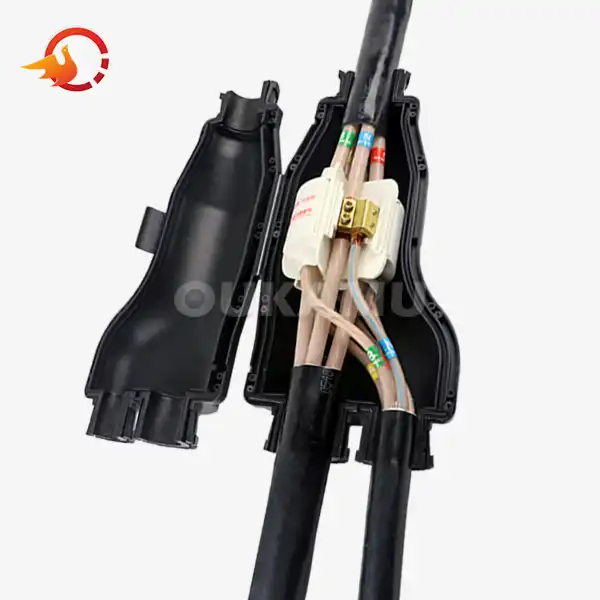
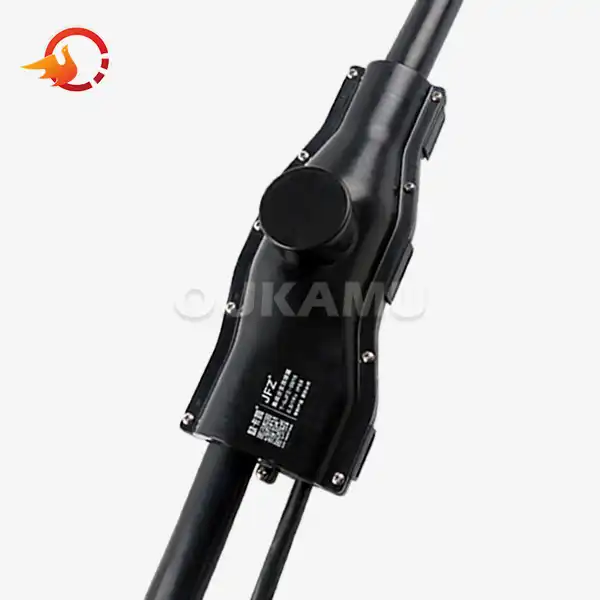
There are three main types that show up in solar project specs. When you use resin encapsulation joints, you pour a compound around the connection that hardens and forms a solid, waterproof shell. This is great for DC feeder cables that are buried directly. When heated, adhesive-lined tubing in heat shrink joints sticks to cable jackets. This type of joint is good for above-ground string wiring. Some mechanical joints, like Oukamu's T-GJFZ-16/10, use pre-load sealing gel inside a clamped case. This cuts down on curing time and lets you connect branches without cutting the main wire.
Materials That Define Sealing Performance
EPDM rubber is much more resistant to damage from ozone and UV light than regular PVC. When it comes to desert or mountain solar sites, the fact that silicone stays flexible from -40°C to 120°C is important. Gel materials have the ability to fix themselves around cable entry points, which lowers the risk of capillary moisture tracking. The IP rating of a joint is directly related to the material used. IP68 is currently the standard for buried or submerged cable connections in solar infrastructure.
Why Waterproof Cable Joints Are Becoming the Industry Standard
The Limits of Conventional Sealing Methods
Heat shrink tubing was the main answer in the area for many years. However, normal polyolefin tubes become brittle and crack after three to five years of being exposed to UV light for a long time in outdoor sun settings. If you don't install standard gel-less mechanical connectors with the right amount of torque, moisture can move along the cable jacket. These types of failure directly lead to arc faults, ground faults, and lost generation, all of which have costs that procurement teams are adding to their total cost of ownership calculations more and more.
Regulatory and Specification Pressure
Article 690 of the National Electrical Code (NEC) and IEC 62548 both talk about how to protect cables in solar systems. A lot of planning, procurement, and construction (EPC) companies now require cable connections with an IP67 or IP68 rating in order to take a job. The approved products are even smaller now that Underwriters Laboratories (UL) has certified PV cable accessories. These specific requirements are making people less likely to buy general heat shrink kits and more likely to buy cable waterproof joints that come with test results that can be checked.
Proven Performance in Field Conditions
Check out this 2022 field report on a 50 MW ground-mounted solar farm in the U.S. Western Electric found that 78% of electrical problems were caused by cable branch connections that weren't properly sealed in direct-buried conduit runs. After the project owner moved all branch points to IP68-rated gel-filled joints, the number of faults dropped by over 60% over the next 18 months of tracking. This kind of evidence makes a strong case for B2B procurement teams: buying approved waterproof joints lowers the number of warranty claims, lowers the cost of dispatching repair crews, and increases the useful life of assets.
Installation and Maintenance Best Practices
Surface Preparation and Joint Assembly
Before any joint assembly, the wire ends must be clean and dry. From the very first day, dirt, moisture, or cable jacket particles can damage the gel seal or adhesive bond. For mechanical gel-filled cable waterproof joints like the T-GJFZ-16/10, you place the branch cable into the connection body, tighten the clamping mechanism to the required pressure, and look for gel displacement at the cable entry ports to see that the seal is complete. You don't need a heat gun, to mix the glue, or to cut the cables.
On-Site Testing and Inspection
| Inspection Step | Method | Acceptance Criteria |
|---|---|---|
| Visual seal check | Make sure the gel can be seen where the cable goes in | Make sure there is gel at all entry points |
| Insulation resistance test | 500V megohmmeter test | ≥100 MΩ |
| Continuity verification | Low-resistance ohmmeter | Match design resistance |
| IP rating field verification | Submersion or pressure test (per IEC 60529) | No moisture ingress after 30 minutes |
For handover records, write down where each joint is, how big the cable is, and the test result after installation. Solar EPC companies are asking for this paperwork more and more as part of the completion sign-off process.

Common Failure Points and How to Avoid Them
The most common installation mistake with gel-filled joints is still not displacing the gel all the way. When clamps are too tight on cables that are too small, they can cut through the insulation instead of compressing the seal. Teams in charge of buying things should make sure that the joint model they choose fits the range of cable diameters that will be used, not just the nominal size shown on the design drawings. For instance, Oukamu's T-GJFZ-16/10 can handle main wires from 4 to 16mm² and branch cables from 1.5 to 10mm², which is enough for most low-voltage PV string and combiner box branch situations.
Choosing the Right Waterproof Cable Joint for Your Solar Project
Key Technical Selection Criteria
Five things should help you choose a product: the IP rating, the wire size range, the voltage rating, the temperature tolerance, and the fitting method. IP68 is the lowest grade that can be used for direct-buried solar DC runs. IP67 may be enough for links in junction boxes that are above ground and open to the weather. Before buying, you should also make sure that the voltage works with 0.6/1kV cable waterproof joint compatibility.
Oukamu T-GJFZ-16/10 Product Specifications
| Parameter | Specification |
|---|---|
| Model | T-GJFZ-16/10 |
| IP Rating | IP68 |
| Main Cable Range | 4–16mm² |
| Branch Cable Range | 1.5–10mm² |
| Rated Voltage | 0.6/1kV |
| Sealing Method | Gel-filled, double safety protection |
| Installation Type | Direct buried / concealed in wells |
| Cable Cutting Required | No |
| OEM Available | Yes |
This product is designed so that branch connections can be made without cutting the main cable. This makes multi-branch feeder runs much easier to do and saves a lot of time.
How Oukamu Compares in the B2B Supply Context
For more than 20 years, Oukamu has been an expert in branch cable connections and cable waterproof joint. The T-GJFZ-16/10 comes with test paperwork that is in line with GB/T standards. This means it can be used for projects that need records of compliance that can be checked.
The company accepts OEM orders, sample requests, and small-batch trials, which is helpful for procurement managers who are doing pilot tests before committing to the whole project. The standard buying process includes responding quickly to lead times and sending invoices that are in line with VAT rules. These are the two most common problems that come up when B2B companies need to buy electrical materials.
Future Trends in Cable Waterproofing for Solar Projects
Advanced Sealing Materials in Development
Next-generation sealing compounds are moving toward bio-based polymers and halogen-free formulations that keep up IP68 performance while making disposal less harmful to the environment. Several companies are trying self-healing elastomers that fill in tiny cracks created by thermal cycling. This is a useful feature for solar systems in places where temperatures change a lot from nite to day.
IoT Integration for Predictive Maintenance
Sensor-embedded joint housings are now being tested in the field. These gadgets put a small moisture-detecting part inside the joint body and send a trouble signal to SCADA systems if the quality of the seal falls below a certain level. This feature turns reactive fault-finding into planned maintenance, which can significantly lower operations and maintenance (O&M) costs per megawatt for big solar farms with thousands of underground join points.
Regulatory Direction
The group in charge of setting standards for PV systems, IEC Technical Committee 82, is currently working on changing the installation rules so that all cable connection points in ground-mounted arrays must have minimum IP ratings. When buying things today, procurement teams should choose cable waterproof joints that are rated IP68 to be ready for changes to specifications that will likely be needed in two to three years.
Conclusion
Cable waterproof joints used to be a specialty option, but now they are required for all solar projects, no matter how big or small. Tougher rules, data on how well things work in the field that can be measured, and higher labor costs make pre-certified, gel-filled mechanical joints the smart choice when buying.
In a single small unit, Oukamu's T-GJFZ-16/10 meets the most important field requirements: IP68 protection, no cable cutting, flexible branch positioning, and proof of compliance. If procurement managers are making lists of suppliers for new solar projects, they should pay close attention to this product group right now, not when the first warranty claim comes in.
FAQ
Can a waterproof cable joint be used in direct-buried solar DC cable runs?
Yes, cable waterproof joints with an IP68 rating, like the T-GJFZ-16/10, have been tested to work with both direct buried soil and continuous submersion. They meet the standards for sealing DC feeder branch links that are buried in solar systems.
What documentation should I request from a supplier before purchasing?
Ask for the IP rating test report (per IEC 60529), the insulation resistance test data, and any GB/T or UL certification papers that are needed. If you ask, a good cable waterproof joint maker will give these to you before you place an order.
Does gel-filling require special tools or training?
No, gel-filled mechanical joints are made to be installed in the field without the need for heat guns, equipment for mixing resin, or special training. The housing already has gel inside it, and all that needs to be done to put it together is to place the wires and tighten the clamp to the right torque.
What cable size range covers most solar PV branch applications?
For branch lines, most string-level links in home and business solar systems are between 4mm² and 10mm². The T-GJFZ-16/10 can handle main wires from 4 to 16mm² and branch cables from 1.5 to 10mm². This means it can be used with most low-voltage PV wiring situations.
How do I verify that an IP68 rating claim is legitimate?
Ask the supplier for the original third-party test report that lists the IEC 60529 test conditions, including the depth and length of submersion. To get a real IP68 approval, something has to be tested for 30 minutes at a depth of at least 1 meter.
Get Waterproof Cable Joints for Your Next Solar Project — Contact Oukamu Today
For 20 years, Oukamu has been making goods that field teams trust that connect branch cables. Sample shipping, OEM configuration, and full compliance documentation for project submissions are all part of the T-GJFZ-16/10 cable waterproof joint supplier program. You can look at product information at okmbranchcable.com, or you can email info@okmbranchcable.com with the cable size needs and project details to get a personalized price within one business day.
References
1. International Renewable Energy Agency (IRENA). Renewable Power Generation Costs. IRENA, 2023.
2. National Fire Protection Association. NFPA 70: National Electrical Code, Article 690 — Solar Photovoltaic Systems. NFPA, 2023.
3. International Electrotechnical Commission. IEC 62548: Photovoltaic (PV) Arrays — Design Requirements. IEC, 2022.
4. International Electrotechnical Commission. IEC 60529: Degrees of Protection Provided by Enclosures (IP Code). IEC, 2013.
5. Wohlgemuth, J. H., & Kurtz, S. Reliability Testing Beyond Qualification as a Key Component in Photovoltaic's Progress to Grid Parity. IEEE Reliability Physics Symposium Proceedings, 2011.
6. Solar Energy Industries Association (SEIA). U.S. Solar Market Insight Report. SEIA, 2023.