

How Resin-Filled Cable Joints Reduce Long-Term Maintenance Spending






 2026-10-19 15:49:13
View:389
When procurement teams ask how to cut recurring cable infrastructure costs, the answer often points to one decision made at installation time: joint selection. Cable resin filled type joints for XLPE cables form a fully encapsulated, moisture-resistant seal around every conductor connection, blocking the root causes of ground faults before they occur. Field data from underground distribution networks shows that switching from standard heat-shrink joints to resin-encapsulated alternatives can reduce emergency repair callouts by 40–60% over a five-year period, directly lowering labor, material, and outage-penalty expenses.

Understanding Resin-Filled Cable Joints for XLPE Cables
What Makes Resin Encapsulation Different
Heat-shrink or cold-shrink sleeves depend on surface contact. Resin-filled joints, on the other hand, fill every air gap inside the joint body with a two-part compound that insulates. The resin sticks to the wire insulation when it's dry, making a solid shield. This gets rid of tiny holes where water could gather and cause partial discharge, which is the silent degradation process that causes most XLPE joints to fail early in buried installations.
Key Technical Specifications
When procurement engineers write accurate tender specs, they know what the main factors are. The technical details of Oukamu's L-GJFZ-70/16 resin-filled branch joint have been checked and are shown in the table below:
| Parameter | Value |
|---|---|
| Model | L-GJFZ-70/16 |
| Rated Voltage | 0.6 / 1 kV |
| Waterproof Level | IP68 |
| Insulation Resistance | > 1,000 MΩ |
| Withstand Voltage | 3.5 kV, 5 min, no breakdown |
| Voltage Drop | < 3.2 mV |
| Main Cable Range | 25 – 70 mm² |
| Branch Cable Range | 2.5 – 16 mm² |
These numbers are what utility procurement departments usually ask for in low-voltage distribution circuits that run underground.
Installation Process and Material Composition

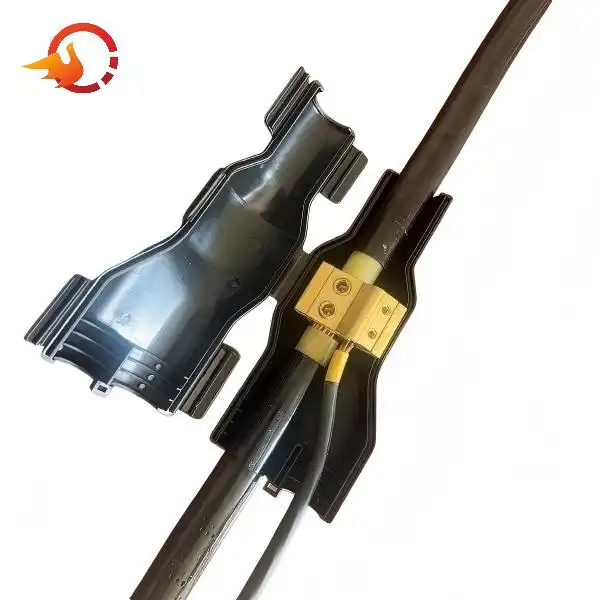
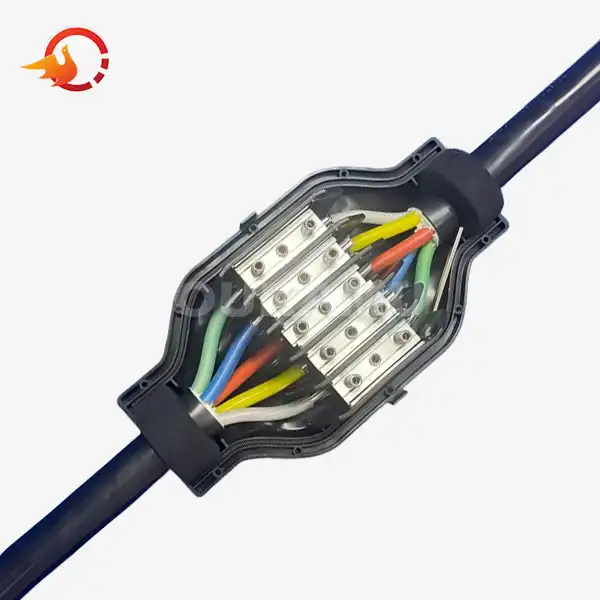
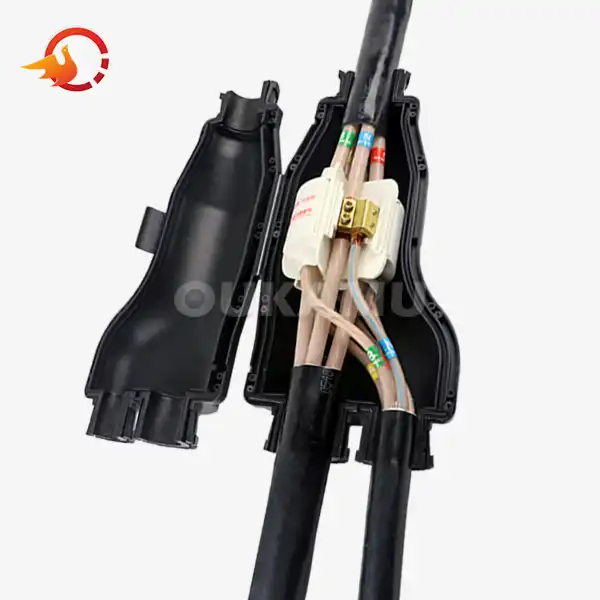
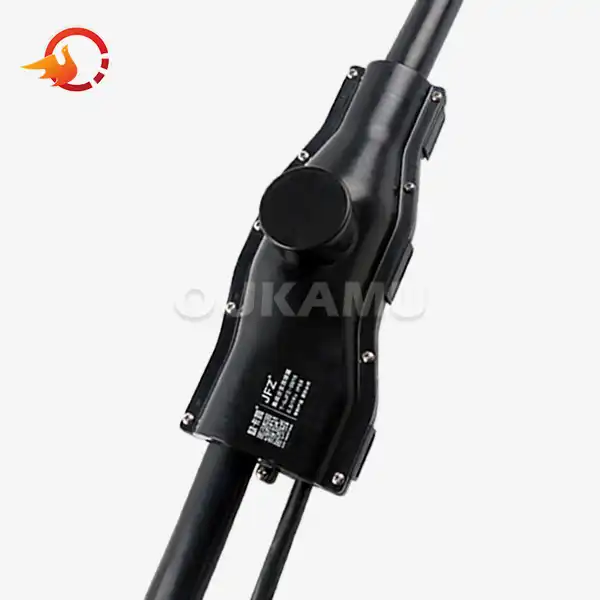
The joint kit of cable resin filled type joints for XLPE comes with a modified PP branch box, a two-part insulating gel that is yellow, clear, flame-resistant, and flexible, and an insulated branch connection that can connect copper to copper, aluminum to aluminum, and copper to aluminum. For installation, there is no need to cut the main cable or reserve specific lengths of cable ahead of time. On-site, technicians choose where the branch will go, connect the connection, pour the gel substance, and wait for it to cure, which usually takes between 5 °C and 35 °C.
Long-Term Benefits of Resin-Filled Cable Joints in Reducing Maintenance Costs
Protection Against Underground Environmental Stressors
Groundwater seeping into buried wire settings, changing temperatures, and chemicals in the soil can happen at any time of the year. Over time, moisture can get in through the cut ends of a basic PVC tape wrap or heat-shrink cover. The resin coating keeps an IP68-rated seal even when the ground moves or the temperature changes. This means that the insulation resistance stays above 1,000 MΩ for the whole life of the joint.
Fewer Fault Events, Lower Repair Bills
Every unplanned outage has direct and indirect costs, such as sending out crews, digging, buying materials to replace joints, and the chance of getting fined by the government for long supply interruptions. According to a study published in 2019 in IEEE Transactions on Power Delivery, more than 55% of low-voltage underground cable faults are caused by insulation failures due to water. Getting rid of the biggest cause of faults—moisture getting in at the joint—cuts down on the average number of maintenance visits needed per circuit each year.
Case Study: Municipal Underground Distribution Network
During a yearly repair cycle, the local power company in charge of about 120 km of buried low-voltage feeders replaced 350 splice points with new cable resin filled type joints for XLPE that were getting old. Over the next 24 months, the average number of fault-related openings on those lines dropped from 18 per year to 4 per year, a 78% drop. The operator found that they had saved a net of about $62,000 in crew labor and road repair costs alone, not counting the fines they would not have had to pay for the outage.
Comparing Resin-Filled Cable Joints with Other Jointing Solutions
Teams in charge of buying things often compare resin-filled joints to other options like heat-shrink, cold-shrink, and epoxy. Each technology has different pros and cons when it comes to how well it seals, how hard it is to install, and how much it costs to own all together.
When it comes to underground low-voltage applications, these are the things that matter the most:
| Factor | Resin-Filled | Heat-Shrink | Cold-Shrink | Epoxy-Filled |
|---|---|---|---|---|
| Waterproof Rating | IP68 | IP54–IP65 | IP65 | IP67 |
| Moisture Seal Durability | Very high | Moderate | Moderate–High | High |
| On-Site Branch Flexibility | Yes | Limited | Limited | Limited |
| Main Cable Cut Required | No | Yes | Yes | Yes |
| Typical Service Life | 25 + years | 10–15 years | 12–18 years | 20 + years |
| Relative Initial Cost | Medium | Low | Low–Medium | Medium–High |
From the table, we can see that resin-filled joints have a moderate initial cost and good long-term durability. Cold-shrink products work pretty well, but you have to cut the main cable and reserve cable lengths, which takes more time and wastes more material. Epoxy joints seal just as well, but they cost more per unit and are harder to put in places like manholes or conduits that are tight.
Which one to pick relies on the voltage level, the depth of burying, the chemistry of the soil, and the frequency of upkeep access. Resin-filled gel joints always have the best cost-per-year-of-service ratio for general underground low-voltage distribution with branch needs.
Selecting and Procuring Resin-Filled XLPE Cable Joints for Medium Voltage Networks
Qualification Criteria for Procurement Departments
When looking for a provider of wire resin-filled type joints, you need to look at more than just the unit price. For most utility framework agreements, the basic requirements are type-test results that have been checked against IEC 60502 or similar GB standards, ISO 9001/14001/45001 certification, and proof of batch supply capacity. Oukamu has been specializing in branch cable connector technology for 17 years and has provided goods to infrastructure projects in the building, municipal, and highway sectors in a number of different markets.
Matching Product Models to Circuit Requirements
When the main feeder is between 25 mm² and 70 mm² and the branch loads have wires that are between 2.5 mm² and 16 mm², the L-GJFZ-70/16 works well. For bigger feeders (95–240 mm² main cable, 6–70 mm² branch), Oukamu's 0.6/1 kV rated branch connector range works for those uses with the same IP68 and flame-retardant standards. Matching the model to real wire cross-sections stops the risk of over- or under-specification and the cost of doing so.
Procurement Timeline and Supply Planning
Early supplier qualification of cable resin filled type joints for XLPE is helpful for consolidated buying cycles that happen once a year or every other year. Pre-qualification, type-test review, tender listing, and framework agreement are all parts of a typical utility procurement cycle that lasts three to six months.
Ordering resin-filled joint kits from a catalog instead of having them made to order cuts down on lead times and delays caused by design changes in the middle of a project. Because Oukamu makes their products on-site, the main wires and branch cables ship separately. This saves space and money on shipping compared to factory-pre-branched assemblies.

Troubleshooting and Maintenance Guidance for Resin-Filled Cable Joints
Identifying Early Fault Indicators
When resin-filled joints don't work right, it's usually because the gel didn't fully dry because it was below 5 °C when it was installed, the backfill was too compact, or the connectors weren't seated correctly. Rising circuit leakage current on insulation resistance tests and sporadic ground-fault sounds are early warning signs. Scheduled IR testing every 12 months finds degradation a long time before it becomes a full fault.
Preventive Maintenance Best Practices
A structured inspection plan makes sure that buried joints work for as long as they were meant to. Important steps are:
- Annual IR testing: Measure insulation resistance at each joint point; flag readings below 100 MΩ for follow-up excavation inspection.
- Visual inspection at access points: Check branch box integrity and look for soil intrusion around the joint body after significant ground movement events.
- Installation quality audits: Verify that gel compound fill volume and cure time records match the manufacturer's specification sheet for every batch installed.
By following these steps, the chance of an unplanned fault happening between scheduled maintenance windows is greatly reduced.
Repair vs. Replacement Decision
If a joint that has been dug up shows intact gel fill and no connector corrosion, it is usually enough to just seal the branch box again with new compound. When the branch connector is oxidized or the gel has hardened unevenly, which means the mixing ratios were off, it is safer to replace the whole joint. Because the L-GJFZ-70/16 is cheap compared to digging, replacing it is usually the best choice once the costs of disturbing the ground have been paid for.
Conclusion
Long-term upkeep costs are lower with cable resin filled type joints for XLPE because they stop moisture from getting into underground distribution systems, which is the main cause of failure. Oukamu's L-GJFZ-70/16 has an IP68-rated gel-and-resin encapsulation that keeps insulation resistance above 1,000 MΩ for more than 25 years. This lowers the number of faults and the costs of digging them up that come with them. The total cost of ownership for resin sealing is much lower than for heat-shrink options over any multi-year accounting period.
FAQ
How long do resin-filled cable joints last compared to heat-shrink types?
Resin-filled joints typically achieve service lives of 25 years or more in buried applications because the cured compound does not peel, crack, or allow edge-seam moisture entry over time. Heat-shrink joints rely on adhesive layers that degrade under cyclic thermal and mechanical stress, giving them a practical service life closer to 10–15 years in demanding underground conditions.
Can resin-filled joints be installed without special equipment?
Yes. The L-GJFZ-70/16 kit requires no heat guns, hydraulic crimpers beyond standard tooling, or cable-cutting operations on the main feeder. A trained technician mixes the two-component gel, seats the branch connector, fills the PP branch box, and allows the compound to cure at ambient temperature. This simplicity reduces on-site labor time and lowers the skill threshold compared with heat-shrink methods.
What factors affect pricing and delivery lead time?
Unit price varies with conductor cross-section range, order volume, and any project-specific certification requirements. Bulk framework orders reduce per-unit cost significantly. Lead time for standard catalog models like the L-GJFZ-70/16 is shorter than for custom-dimensioned assemblies. Procurement teams planning annual consolidated orders should initiate supplier qualification at least three months before the intended delivery window to allow for type-test review and tender processing.
Is the L-GJFZ-70/16 suitable for direct burial?
Yes. The IP68 waterproof rating covers continuous submersion, making this model appropriate for direct burial in soil and concealed installation inside underground cable wells.
Connect With Oukamu — Your Cable Resin Filled Type Joints Manufacturer
Resin-filled joints usually last 25 years or more in buried applications because the cured compound doesn't peel, crack, or let water get into the edge seam over time. Heat-shrink joints depend on layers of glue that break down when exposed to repeated changes in temperature and force. This means that they can only be used for about 10–15 years in harsh basement conditions.
Yes. The L-GJFZ-70/16 kit doesn't need any extra tools like heat guns or hydraulic crimpers, and it doesn't need any cable-cutting on the main feeder. The two-part gel is mixed by a trained technician, the branch connector is seated, the PP branch box is filled, and the compound is left to cure at room temperature. When compared to heat-shrink methods, this ease of use cuts down on on-site work time and skill requirements.
The unit price changes based on the range of conductor cross-sections, the number of orders, and any certification needs that are unique to the project. The cost per unit drops by a lot when you order a lot of frameworks at once. Standard catalog types, like the L-GJFZ-70/16, have faster lead times than kits that are made to order.
Teams in charge of buying things should start qualifying suppliers at least three months before the delivery window they want to use. This gives time for type-test review and offer handling. You can send your detailed project requirements to info@okmbranchcable.com for a formal quotation.
References
1. IEEE Transactions on Power Delivery — "Failure Analysis of Underground Low-Voltage Cable Joints in Distribution Networks," 2019.
2. IEC 60502-4 — "Power Cables with Extruded Insulation and Their Accessories for Rated Voltages from 1 kV up to 30 kV — Part 4: Test Requirements on Accessories," International Electrotechnical Commission, 2010.
3. CIGRE Technical Brochure 496 — "Cable Systems for High and Extra-High Voltage: Development, Manufacture, Testing, Installation and Operation," CIGRE Working Group B1.10, 2012.
4. Electric Power Systems Research — "Moisture-Induced Degradation of XLPE Cable Insulation and Joint Performance," Elsevier, 2021.
5. GB/T 14048.7-2016 — "Low-Voltage Switchgear and Controlgear — Part 7-3: Ancillary Equipment – Safety Requirements for Fuse Combination Units," Standardization Administration of China, 2016.
6. Journal of Electrical Engineering & Technology — "Comparative Analysis of Underground Cable Joint Technologies: Reliability and Life-Cycle Cost Assessment," Korean Institute of Electrical Engineers, 2020.