
Which cable connectors are suitable for outdoor applications?






 2026-11-18 14:45:04
View:389
When it comes to outdoor electrical installations, selecting the right cable connectors directly impacts project longevity and safety. Waterproof cable connectors stand out as the preferred solution for environments exposed to rain, humidity, dust, and temperature fluctuations. These specialized connectors create secure seals that prevent moisture ingress, protecting electrical circuits from short circuits, corrosion, and signal degradation. Whether you're managing infrastructure projects in tropical climates or installing outdoor lighting systems, understanding which connectors meet your specific environmental challenges ensures reliable performance and reduces costly maintenance interventions down the line.


Understanding Outdoor Cable Connectors and Their Importance
When installing electrical systems outside, they have to deal with problems that indoor systems never have to. Extreme temperatures, rain, humidity, and dust storms can quickly damage normal electrical connections, breaking down equipment and putting people in danger. Because of this, waterproof wire connectors are an important part of any job that will be done outside.
What Makes a Connector Truly Waterproof
The main way that waterproof connectors are different from regular connectors is how they seal. These gadgets have gaskets, O-rings, or built-in sealing compounds—mostly made of silicone or special types of rubber—that press against the surfaces they fit against to stop moisture from getting in. The difference between "waterproof" and "watertight" is very important when buying things. Watertight designs only make it hard for water to get in, while waterproof joints stop water from getting in at all. For outdoor uses in Southeast Asia's monsoon conditions, this difference can mean the difference between your building staying put during the rainy season and breaking.
The IP Rating System Explained
The Ingress Protection (IP) rating system is a standard way to check how well a connector protects against outside influences. An IP grade is made up of two numbers. The first number (0–6) shows protection against solid particles, and the second number (0–8) shows protection against liquids getting in. IP65-rated connectors can withstand low-pressure water jets coming from any direction, so they can be used for outdoor installs that will be open to the weather.
IP67 connectors can handle being submerged up to one metre for thirty minutes. This makes them perfect for setups that are close to the ground and could leak. IP68-rated products offer continuous submersion protection, which is important for uses underground or in marine environments where saltwater is present all the time (IEC, 2013).
Business Impact of Proper Connector Selection
Picking the right waterproof connectors has a direct effect on your bottom line. Signal loss caused by moisture getting in can mess up operations and hurt sensitive equipment. Corrosion speeds up the replacing cycle, which raises the cost of materials and labour. Industry studies show that choosing the right connectors can cut down on repair needs by up to 40% over the first five years after installation. When distributors in Vietnam, Thailand, and Indonesia work with contractors and industrial facilities, suggesting certified waterproof solutions builds trust and gets customers to buy from them again.

Key Types of Waterproof Cable Connectors for Outdoor Use
There are different types of waterproof connectors on the market, and each one is made for a different fitting situation and set of performance needs. Knowing these differences helps you find products that fit the needs of your project.
Screw-Type Cable Glands
Cable glands, which are sometimes called "cord grips," are one of the most flexible ways to connect things that need to be waterproof. These parts—a threaded body and a locking nut—sit between the enclosure wall and make a sealed opening for cables to go through electrical boxes. The gland squeezes a cushion around the cable sheath. This keeps the seal strong even when the wires move or vibrate.
There are different types made of brass, stainless steel, aluminium, nylon, and plastic to fit different budgets and needs for corrosion resistance. Metal glands are often used in factories and wastewater treatment plants because they last a long time. On the other hand, nylon glands are less expensive and can withstand UV light.
Heat Shrink and Self-Fusing Solutions
When connecting two wire pieces outside, heat shrink tube with an adhesive layer keeps the connections waterproof. For this method, you need to cut the tubing so that it overlaps the insulation on both ends of the wire. Then, you need to use controlled heat from a heat gun to shrink the material and set the adhesive seal. The process makes a permanent connection that can't be broken.
It can be used for both buried cables and overhead lines. Another option is self-fusing silicone tape, which doesn't need any tools to use. Just wrap the tape around the link with a lot of extra space between the layers, and the material will stick together to form a waterproof shield. Both ways work well for repairs in the field and making custom branch links when ready-made solutions don't work.
Branch Cable Connector Technology
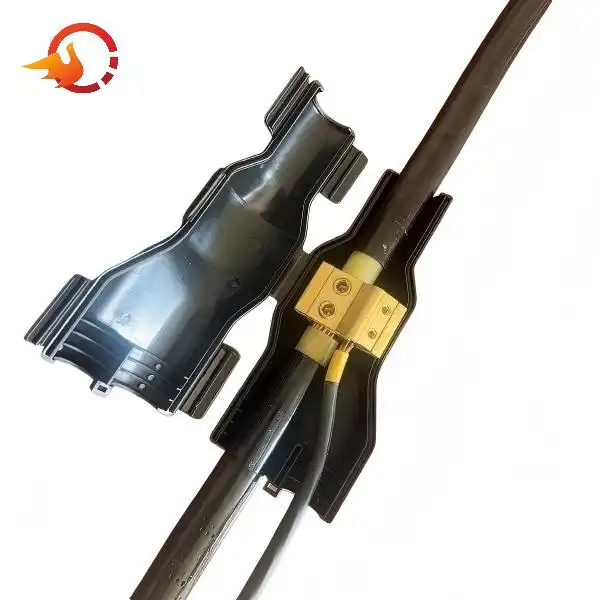
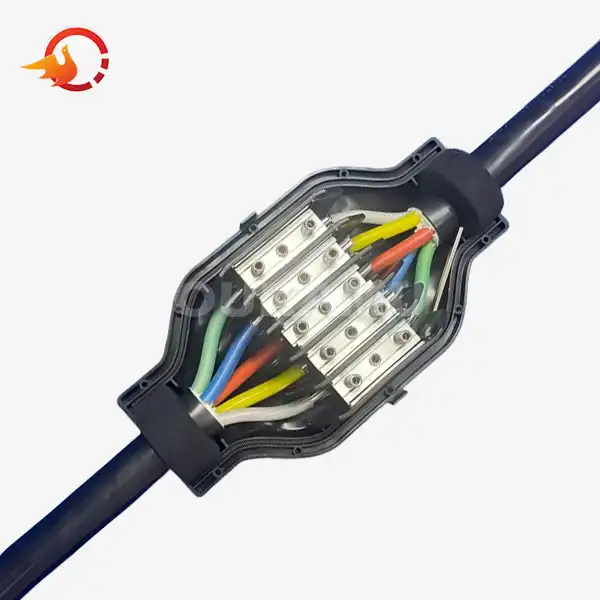
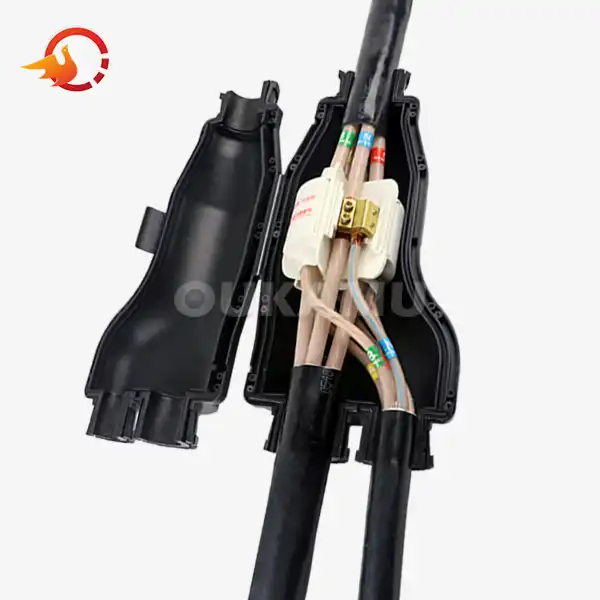
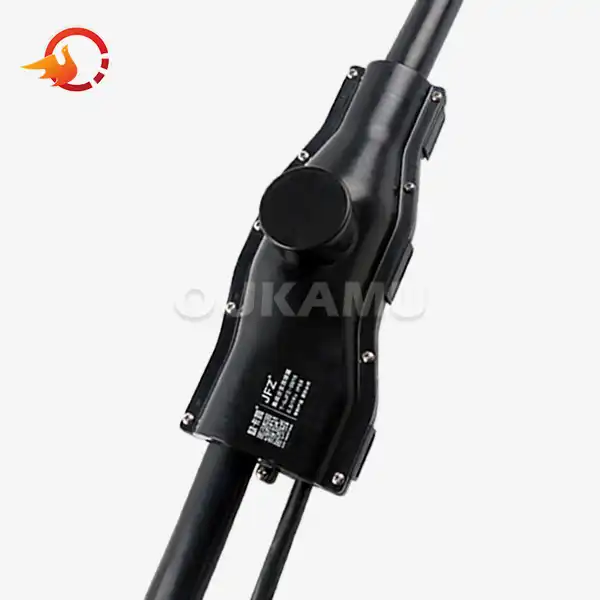
Specialised branch plugs let you connect cables on-site without cutting the main trunk line, which is very helpful for distribution systems that are very complicated. For almost twenty years, Xi'an Oukamu Electric has been at the forefront of this technology, creating combined solutions that let installers add branch points anywhere along the main line, using waterproof cable connector to ensure reliable, moisture-resistant connections in harsh environments.
This adaptability gets rid of the waste that comes with prefabricated branching cables, whose fixed branch positions don't always match up with the conditions on the job site. The body of the connection is small and has insulation, flame retardancy, and waterproofing built in. It can be used for either open installation or confined bridge fixing. The technology is being used in a lot of building, city infrastructure, railroad, and highway projects all over Asia.
Table 1: Comparison of Waterproof Connector Types
| Connector Type | IP Rating Range | Installation Complexity | Primary Applications | Material Options |
|---|---|---|---|---|
| Cable Glands | IP65-IP68 | Low | Junction boxes, control panels, enclosure entries | Brass, stainless steel, nylon, aluminum |
| Heat Shrink Tubing | Equivalent to IP67 | Medium (requires heat gun) | Wire splices, repair connections, underground cables | Adhesive-lined polyolefin |
| Self-Fusing Tape | Equivalent to IP65 | Low | Emergency repairs, temporary connections, irregular shapes | Silicone rubber |
| Branch Connectors | IP54-IP65 | Medium | Main cable branching, distribution systems | Flame-retardant polymers with rubber seals |
Material Selection and Environmental Resistance
The long-term performance of a connector under certain environmental stresses depends on the material it is made of. Plastic and nylon connections are less expensive and have good corrosion protection and electrical insulation. This makes them good for projects that need to stay within a budget and will be exposed to mild weather conditions. It is important for tropical installations that these materials have UV stabilisers built in so that they don't break down when they are exposed to direct sunlight for a long time.
Brass connectors are great for high-vibration industrial settings because they are very strong and good at conducting heat. Stainless steel types work best in marine settings where saltwater vapour would quickly eat away at other materials. To choose materials that meet your project's specific environmental challenges, like UV exposure, chemical exposure, temperature extremes, or mechanical stress, you need to know about them.

How to Choose the Right Waterproof Cable Connector for Your Outdoor Project
When making procurement choices, you have to weigh a lot of technical factors against project deadlines and price limits. The best results are guarantyd by a systematic picking method.
Matching IP Ratings to Environmental Conditions
The minimum IP grade needs depend on where the work is being done. Outdoor lights on the outside of a building that is likely to get wet from the wind needs to be protected by at least IP65. Connections to conduits that are buried and could leak sometimes need IP67 grades or higher.
Offshore facilities or equipment near water features need to meet IP68 standards so that they can handle situations where they might get submerged. A lot of the time, distributors have clients who don't specify enough protection levels to save money, which leads to early failures and warranty claims. Taking the time to figure out the real outdoor exposure, including the worst weather events, stops these problems before they happen and builds relationships with customers that last.
Cable Compatibility and Sizing
Connectors must be able to physically fit the size of your wire while still keeping the purity of the seal. Oukamu's branch cable connectors can fit main cables with cross-sections ranging from 95 mm² to 240 mm² and branch cables with cross-sections ranging from 6 mm² to 70 mm². This covers most low-voltage distribution tasks at a rated voltage of 0.6/1kV. Cable glands have ranges of entry diameters.
If you choose a gland that is too big for your cable, the gasket seal will be compromised, and if you choose a gland that is too small, the cable will not be able to be inserted at all. Power cables, control cables, and sensor cables often have different cover materials and constructions, which means that they need different gland or connector designs to close properly.
Certification and Standards Compliance
International approvals back up claims about a product's safety and performance. UL (Underwriters Laboratories) approval shows that the product meets North American safety standards, while CE marking shows that the product meets European Union rules. RoHS compliance confirms that dangerous substances are limited, which is becoming more and more important for procurement policies that care about the environment.
The Chinese standard GB/T 14048.7-2016 controls low-voltage switchgear and controlgear assemblies. This makes sure that products meant for the Asian market are safe. When reviewing suppliers, make sure they give you all the paperwork you need, like test reports and certification numbers.
Real makers will happily give you this info, but shady suppliers will usually avoid giving it to you (IEC, 2013). In particular, for any connection component such as a waterproof cable connector, compliance with this standard is critical, and trustworthy manufacturers will readily provide corresponding test documentation to prove its performance under damp or wet conditions.
Application-Specific Considerations
Different fields have different needs for how well connectors work. Connectors used in solar installations need to be very resistant to UV light and be able to handle large changes in temperature, since equipment on rooftops is exposed to these extremes every day. EMI/RFI shielding may be needed in industrial manufacturing settings to keep electromagnetic interference from messing up sensitive control systems.
Offshore equipment needs materials that don't rust and can handle being exposed to saltwater all the time. Flame-retardant and fire-resistant connectors keep circuits intact during emergencies, so lighting and warning systems can keep working. These connectors are useful for highway infrastructure projects that last for many years.
Case Study: To save money, a Vietnamese contractor who was putting up streetlights in a coastal town first asked for standard IP54 connections. Within eight months, salt air corrosion broke connections in 23% of devices that had been placed. It cost 2.8 times as much to replace broken units and upgrade the rest of the installs to stainless steel IP67 connections. This shows why good design based on real-world environmental conditions saves money in the long run, even if it costs more up front.
Balancing Cost and Quality
The people who work in procurement are always juggling the need to stay within budget and meet quality standards. When you add up the cost of replacement labour, equipment downtime, and reputation damage from failed installations, the cheapest connector is often the worst choice.
Manufacturers with a good reputation back up their products with warranties that usually last between two and five years for good waterproof plugs. Ask for full product datasheets that show test results, material requirements, and instructions on how to use the product. Samples let you try something out before you commit to buying a lot of it. This is especially helpful when you're bringing new product lines to the market.
Installation, Testing, and Maintenance of Waterproof Cable Connectors
If it's not installed correctly, even the best waterproof connector won't work. Following a set of steps makes sure that the link stays solid throughout the span of the product.
Installation Best Practices
Preparing the area correctly is the first step to making waterproof links that work. Get rid of any dust, oil, or oxidation that might be on the surfaces that fit together by cleaning them. When placing cable glands, make sure that the cable sheath goes far enough into the enclosure (usually 50–75 mm, but this depends on the size of the cable) to keep the internal wires from being stressed.
Thread engagement should be complete, and the locking nut should be tightened to the manufacturer's specifications. If it's not tight enough, water can get in, and if it's too tight, gaskets can deform and leak paths can form. When using a branch cable connection, make sure the body of the connector is lined up correctly with the main wire before you tighten the clamping mechanisms. Installers need to make sure that the strain relief features grip the cable sheath properly and don't damage the outer jacket.
Verification and Testing Procedures
Testing makes sure the work is done right before the wires are turned on. A visual inspection makes sure that the gasket is properly seated, that all the threads are engaged, and that there are no gaps between the mating surfaces. When you do pressure testing, you put air or water pressure above the rated IP protection level. For IP67 plugs, this means testing them in water one metre deep for at least thirty minutes while checking for moisture inside.
These steps are easier to do with commercial test tools, but for small-scale proof, simple immersion testing in containers is enough. Continuity checking with a multimeter makes sure that electrical links stay strong after the sealing steps are done. Record test results to set benchmarks for performance and back up warranty claims if problems arise later.
Ongoing Maintenance Requirements
Waterproof connections don't require no upkeep at all. By inspecting things on a regular basis, problems can be found before they become major problems. Check for seal wear, especially in places where temperatures can change quickly or where chemicals are present. Clean the outside of connectors to keep dirt from building up and preventing moisture from getting to the seals.
Check that the attaching hardware is still tight. For any waterproof cable connector, these maintenance steps are equally essential, as its long-term reliability depends on regular seal inspection, external cleaning, and hardware torque verification to prevent gradual degradation in harsh environments.
Over months of use, vibration can loosen screws. If you see signs of rust, breaking, or deformation in any connections, you should replace them instead of trying to fix them. Keeping maintenance logs helps find batches of products that aren't working right or installation methods that need to be changed. These easy steps greatly increase the service life of the connection and lower the number of emergency repair calls.
Leading Brands and Solutions for Waterproof Cable Connectors in 2026
There are both well-known international companies and specialised regional companies in the global waterproof connector market. Each has its own benefits for business-to-business buyers.
International Industry Leaders
The high-specification market is dominated by big names like TE Connectivity, Amphenol, and Phoenix Contact, which have huge product lines and global marketing networks. These companies put a lot of money into research and development, which helps them make new connector designs using better sealing technologies and higher-quality materials.
Their goods usually have full certifications for a number of foreign markets and come with a lot of expert help resources. Because they focus on OEM relationships and big infrastructure projects, their minimum order quantities tend to be higher. Delivery lead times vary from four to twelve weeks, depending on how the product needs to be customised.
3M is an expert in heat shrink and sealing solutions. They offer full systems that include adhesive-lined tubing, sealant compounds, and tools for using them. A lot of people use their products in utility installations and telecommunications infrastructure. The price represents its high-end positioning, but for mission-critical applications, the dependability and full application engineering support make the price worth it.
Regional Specialists and Value Providers
Since they've put money into modern factories and quality control systems, Chinese manufacturers are competing more and more on both price and quality. With seventeen years of experience specialising in branch cable connector technology, Xi'an Oukamu Electric is a great example of this type of company. The business has patents for new cable branch joint designs and makes products that meet GB/T 14048.7-2016 standards. This makes sure that the products work with Asian infrastructure needs and keeps prices low.
Oukamu branch wire connections help Southeast Asian wholesalers and builders. Prefabrication waste may be eliminated by making branch connections on-site. This normally saves 2–3 meters of main line per connecting point. An integrated design with fire resistance, flame retardancy, insulation, and sealing simplifies installation and reduces part count. High-density urban buildings have narrow installation spaces, thus the tiny construction works well. The devices can handle voltage levels of 0.6 to 1kV with main cable widths of 95 to 240 mm³ and branch cable sizes of 6 to 70 mm². This makes them suitable for most low-voltage distribution applications.
Table 2: Oukamu Branch Cable Connector Specifications
| Parameter | Specification | Application Benefit |
|---|---|---|
| Rated Voltage | 0.6/1kV | Suitable for standard low-voltage distribution systems |
| Main Cable Range | 95-240mm² | Accommodates common trunk line sizes in building and infrastructure projects |
| Branch Cable Range | 6-70mm² | Supports diverse branch circuit requirements from lighting to equipment feeds |
| Installation Method | On-site connection without cutting main cable | Reduces cable waste and allows flexible branch positioning |
| Protection Features | Insulation, flame retardant, fire resistant, dustproof, anti-aging, anti-corrosion | Comprehensive environmental protection for outdoor and harsh industrial environments |
| Structural Advantage | Compact design for open or confined installation | Enables installation in cable bridges, trenches, and tight spaces |
| Standards Compliance | GB/T 14048.7-2016 | Ensures quality and safety for Asian market requirements |
Customization and Bulk Ordering Options
For big orders, well-known makers usually offer customisation services that let you change the connector's size, material, or cable entry layout to fit the needs of your project. For standard products, the minimum order quantity is usually between 100 and 500 units. For customised versions, it may be 1,000 or more units. For custom orders, lead times can be eight to sixteen weeks, so the job needs to be carefully planned.
Payment terms depend on the seller and the size of the order. Many Asian makers can accept TT (telegraphic transfer) payments, which is how most Southeast Asian distributors like to pay. Managing inventory costs and cash flow is easier with incremental delivery plans. This is especially helpful for wholesalers who don't have a lot of warehouse space.
Oukamu helps distributors and builders choose the right connector types for their projects by giving them expert advice. Technical documentation written in English that is very detailed helps with sales and training for end users. The company has flexible minimum order amounts that can be used for testing the market before committing to bigger inventory investments.
This helps solve a common worry among distributors who are moving into new product categories. They focus on branch connector technology instead of competing on all connector types. This gives Oukamu specialised knowledge that goes beyond just supplying products.
Conclusion
To choose the right waterproof cable connectors for outdoor use, you need to know about the difficulties of the climate, the technologies used in the products, and how they need to be installed. When you choose the right material for an IP-rated connector, it protects electrical links from wetness, dust, and external stresses that can cause them to break down early. Cable glands, heat shrink solutions, and specialised branch connectors are all used in different installation situations.
To get reliable long-term performance, make sure you match the right technology to your project. Certification compliance, using the right installation methods, and regular upkeep all help to stretch the life of connectors and lower the total cost of ownership. Investing in high-quality waterproof connections keeps expensive failures from happening and builds a reputation for delivering reliable electrical systems, whether you're specifying products for city infrastructure, industrial facilities, or commercial construction.
FAQ
What IP rating do I need for outdoor cable connectors?
For outdoor connectors, IP65 is the lowest rating that is suggested. This rating guards against dust getting in and low-pressure water jets coming from any direction. This is good for most outdoor installations that will be seen, like outdoor lighting and equipment that is above ground. Applications that might be flooded or mountings that are low to the ground should specify IP67, which protects against short-term soaking up to one metre. IEC (2013) says that tools or systems that are buried or close to water features need to have an IP68 grade for continuous submersion protection.
How can I verify a connector is truly waterproof and not just weatherproof?
Waterproof connectors completely keep water out, but weatherproof goods only protect against the weather without ensuring that water won't get in at all. Instead of relying on marketing terms, look for specific IP ratings. For example, IP67 or IP68 ratings show that waterproof performance has been proven through standard testing. Ask suppliers for test reports and certifications. Manufacturers with a good reputation give out detailed technical documentation that includes results from immersion tests. Watch out for vague words like "water-resistant," which only means that water won't damage the material and doesn't mean that it won't let water into the connection.
Are waterproof cable connectors suitable for marine environments?
Yes, but the choice of material is very important. Saltwater environments need housings made of stainless steel or a special kind of plastic that doesn't rust. When exposed to salt air, standard metal or aluminium connections rust very quickly. If the product is going to be used in water, make sure it has an IP68 rating. Marine systems need to have their joints checked and maintained on a regular basis, because even stainless steel will rust after being exposed to saltwater for a long time. Some companies make marine-grade versions that have better sealing compounds that are made to withstand saltwater.
Partner with Oukamu for Reliable Waterproof Cable Connection Solutions
Contractors and distributors all over Southeast Asia accept Oukamu's seventeen years of experience in branch cable connection technology. Our patented solutions allow for adjustable installation on-site without cutting the main wires. This cuts down on trash and labour costs while still being able to handle the complex topology that is common in modern building projects.
The products meet the requirements of GB/T 14048.7-2016 and have built-in fire safety, waterproofing, and corrosion protection that are perfect for warm regions. As a company that only makes waterproof cable connectors, we know how hard it is for regional wholesalers to keep up with their supplies and stick to their budgets. You can choose from different minimum order quantities at Oukamu. They also have competitive tiered pricing and full English technical documentation to help you with your sales.
Email our team at info@okmbranchcable.com to talk about the specifics of your project, get product samples, or get detailed datasheets. Visit okmbranchcable.com to see all of our products and learn how our creative cable connection solutions can help your business stand out in a crowded market.
References
1. Electrical Engineering Portal. (2021). Cable glands: Types, selection and installation.
2. Family Handyman. (2022). How to waterproof electrical connections.
3. IEC. (2013). IEC 60529: Degrees of protection provided by enclosures (IP Code). International Electrotechnical Commission.
4. Polycase. (2024). What is a waterproof cable gland?
5. RS Components. (2023). Cable glands guide: Materials, types and IP ratings.
6. Xuanyuan Cable. (2022). Difference between watertight and waterproof connectors.