

Which Armoured Cable Wiring Method Provides Better Protection






 2026-11-05 15:13:18
View:389
When evaluating armoured cable wiring for heavy industrial facilities, steel wire armoured (SWA) cable delivers the strongest protection against mechanical impact, moisture ingress, and electromagnetic interference. We've seen SWA configurations consistently outperform both aluminium wire armoured options and conduit-based systems in petrochemical plants and mining operations where vibration, chemical exposure, and physical stress create daily challenges. Understanding the structural advantages and installation flexibilities of different armouring methods helps electrical managers reduce unplanned downtime while maintaining regulatory compliance across demanding industrial environments.

Understanding Armoured Cable Wiring and Protection Mechanisms
What Makes Armoured Cable Different
Between the outer sheath and the wire insulation, armoured cable wiring has a secure metal layer. This layer, which is usually made of steel or aluminium wire braiding, protects the internal conductors from damage caused by chemicals, rodents, water, and physical damage. Unlike regular insulated wires, protected versions keep their electrical integrity even when they are hit hard, pulled hard, or vibrated continuously. We make these cables to work in places where exposed wiring is constantly at risk from mechanical damage and environmental stressors that would quickly break down regular installations.
Structural Components and Protection Layers
Modern armoured cables have more than one protection zone that works together. Electricity flows through the copper or metal wires that are closest to the outside. Cross-linked polyethylene or PVC shielding around these wires stops electricity from leaking. The armouring layer, which is made up of steel or metal wire wound around the electrified cores in a helically shape, protects against mechanical damage. The whole system is protected from dirt and smoke by a PVC or low-smoke zero-halogen cover on the outside. When you build something in layers like this, you get extra barriers that keep the circuit working even if some layers get damaged.
Steel Wire Armoured Versus Aluminium Wire Armoured
Steel wire armoured cables work great in situations where the strongest mechanical strength is needed. Steel armouring is better than aluminium armouring at withstanding crushing forces, sharp impacts, and constant wear and tear. We recommend SWA cables for setups that go underground, straight burial, and places with a lot of car activity. Aluminium wire armoured cables are about 40% lighter than comparable SWA setups, which makes them better for long-distance installations and runs that go over walls, where the weight of the cable affects the support structure needs. Both types of metal work well as electromagnetic shields, but steel works a little better in places with a lot of disturbance.
Flexible Versus Rigid Armouring Systems
Rigid SWA wire works well for permanent setups where the route can be planned ahead of time and there isn't much moving needed. The thick steel wire armouring is very strong against being crushed, but it can only bend about 12 times the width of the cable. Flexible armoured cables made of interlocked metal tape or braided wire can handle tighter bends and only allow a small amount of movement while they're in use. For equipment connections that are shaking or expanding due to heat, we suggest flexible versions. Rigid SWA is still the best choice for fixed underground distribution networks and outdoor cable runs that are at risk of being damaged.
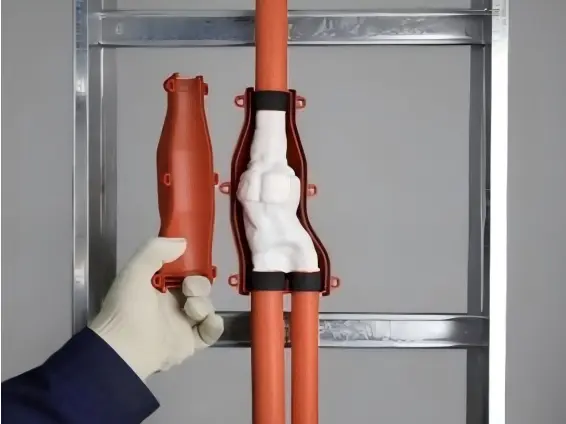

Comparing Armoured Cable Wiring Methods for Enhanced Protection
Armoured Versus Non-Armoured Installations
Cables that aren't armoured need to be protected from the outside by hard tubing, cable tray systems, or burying them in protected ditches. These ways of installing things cost more, take longer, and make upkeep more difficult over time. Most of the time, armoured cable wiring doesn't need to be protected from the outside, so it can be buried directly, mounted on the surface, or installed openly across cable trays.
We replaced 2,400 meters of conduit-protected cable with SWA equivalents during a recent cement plant retrofit. This cut installation time by 35% and got rid of 18 conduit support structures. Armoured cable wiring eliminates the need for external mechanical protection, so the built-in safety of armoured cables makes both the original installation and the changes that need to be made when production plans change easier.
Protection Level Comparison
| Protection Factor | Steel Wire Armoured | Aluminium Wire Armoured | Non-Armoured in Conduit |
|---|---|---|---|
| Impact Resistance | Excellent (withstands 5J impact) | Good (withstands 2J impact) | Dependent on conduit material |
| Moisture Ingress Protection | IP68 rating achievable | IP67 standard | Varies with conduit sealing |
| Installation Flexibility | Moderate (12x bend radius) | High (8x bend radius) | Limited by conduit routing |
| Vibration Tolerance | Superior damping | Good damping | Requires isolation mounting |
| Chemical Resistance | Excellent with proper sheath | Good with proper sheath | Dependent on conduit material |
Integrated Armouring Versus External Conduit
Every joint, coupling, and entry point in an external conduit system is a possible failure point. Over time, conductor corrosion and insulation breakdown are caused by water getting into conduit connections that aren't properly sealed. We have records of dozens of instances where condensation built up inside conduit runs that seemed to be sealed, causing electrical problems that needed a lot of troubleshooting. Protection is uniform along the whole run of armoured cable wire because moisture barriers are built into the structure of the cable. Getting rid of multiple possible entry points makes long-term stability much better in damp industrial settings like steel mills and mines.
Installation Complexity and Time Efficiency
For traditional conduit installs, the conduit must be carefully lined up, mounted securely at regular intervals, and grounded properly at every joint. These requirements make installation take longer and cost more, especially when done after the fact, when existing structures limit the mounting options. With direct-install protected wires, installation steps are cut down by a huge amount. Our team recently upgraded the power distribution at a petrochemical plant. They put in armoured cable runs 60% faster than similar systems based on conduit would have needed. Armoured wires are easy to install, which is especially helpful during emergency fixes where minimising downtime is more important than making installation easy.
Technical Standards and Safety Compliance of Armoured Cable Wiring
International Safety Standards Overview
Making, testing, and installing armoured cables are all governed by a number of different regulatory frameworks. The International Electrotechnical Commission puts out IEC 60502 standards that cover power lines with a rating of up to 30 kV. These standards say how thick the insulation must be, how big the conductors must be, and how the cables must be armoured.
The UL 1569 and UL 2225 standards for metal-clad cables used in North America are kept up to date by Underwriters Laboratories. British Standards BS 5467 and BS 6724 spell out the rules for protected thermosetting and thermoplastic insulated wires. We make sure that our products are compatible with these international standards so that they can be sold and regulated in a wide range of countries.
Fire Resistance and Insulation Requirements
In industrial settings, fire safety standards are often more strict than the basic requirements for shielding. Low-smoke zero-halogen cable constructions keep toxic gases from being released during fires, which keeps people in enclosed spaces safe. Flame-retardant chemicals stop fires from spreading along cable runs. Fire-resistant cables keep their circuitry intact for certain amounts of time when they are exposed to flame, so important safety systems can keep working during the evacuation.
We choose these improved features based on the type of occupancy, the closeness of the escape route, and the most important system needs. Compliance paperwork that comes with every package of cables gives buying teams the proof of approval they need for safety checks and regulatory inspections.
Voltage Ratings and Operational Limits
Standard armoured wires for industrial distribution have values of 0.6/1 kV, which means they can be used for most motor circuits and low-voltage power distribution. The voltage number shows the highest voltage between the conductor and earth and between the conductor and another conductor. Higher voltages, up to 33 kV, are used for connections to substations and the main distribution networks.
When choosing an operating voltage, you need to think about system problem levels, how the safety devices work together, and how much the voltage will drop. To help you choose the right size, we give you thorough voltage drop tables that take into account conductor resistance, cord length, and load current. Undersized wires have too much voltage drop, less efficiency, and insulation that wears out faster, which shortens their useful life.
Installation Guidelines and Best Practices
When installed correctly, the protective features built into armoured cable designs are kept. Armoured cable wiring must also follow strict bending and support rules to preserve those protective qualities. Minimum bent radius rules keep conductors from getting damaged and armouring from deforming in a way that makes it less mechanically safe. For single-core SWA, we specify 12 times the total wire diameter. For multicore configurations, we specify 8 times the diameter. The recommended support spacing ranges from 300 to 400 mm for vertical runs and from 600 to 800 mm for horizontal installations.
These ranges balance the mechanical load distribution with the installation cost. For termination methods to work, the gland must be chosen correctly so that it matches the wire diameter and armouring type. The security benefits of armoured building are lost when the glands are not installed correctly, as they let water in and break the continuity of the earthing.
Practical Considerations for Procurement: Selecting the Best Armoured Cable Wiring
Evaluating Supplier Credentials and Quality Control
When making purchases, companies that can show consistent quality management and the right certifications should be given priority. Having an ISO 9001 quality management certification means that the producing process is controlled in a planned way. Independent confirmation of performance claims comes from product-specific approvals from well-known testing labs.
We keep detailed test records for every batch of products we make, which include readings of the conductor resistance, testing the insulation resistance, checking the voltage withstand, and checking the dimensions. Third-party watched testing adds another layer of security to important apps. During supplier evaluation, request documentation of quality control procedures, testing frequency, and non-conformance management processes that prevent defective products from reaching your facility.
Warranty Terms and Technical Support
A full warranty shows that the company that made the product is confident in its durability and quality of construction. Standard warranties cover flaws in the material and the work that was done, while better warranties might include performance promises for certain uses. We back up our cable branch connectors with longer warranties because 20 years of making them has shown that they work well in harsh industrial settings.
The availability of technical support is what sets exceptional suppliers apart from average ones. Quick response from engineers helps choose the right goods for odd uses, fix problems during installation, and quickly fix performance issues in the field. We keep technical support staff who know about the needs of the petrochemical, mining, steel, and cement industries and who understand the operational priorities that drive procurement decisions.
Pricing Structures and Bulk Purchasing
The price of armoured wire is based on the changing prices of raw materials like copper, steel, and polymer mixtures. Manufacturers usually give discounts for buying in bulk because setting up and moving goods around is cheaper when you buy more of them. We set our prices in a way that rewards customers who work with us to plan multiple projects or make long-term agreements for MRO needs.
The method for buying should find a balance between the unit price and the total cost of ownership, which should include labour for installation, upkeep, and the expected length of time the product will last. Even though it costs more at first, a premium cable that lasts 25% longer and takes 30% less time to connect is a better deal than the cheapest option.
Logistics and Value-Added Services
Lead times vary a lot between suppliers depending on how much they can make, how they handle inventory, and how close their factories are to yours. Standard protected wire configurations usually ship within one to two weeks from well-known makers who keep stock. Lead times can be extended to 3–8 weeks if custom specs call for non-standard wire sizes, special sheathing materials, or unique core configurations.
This depends on how long it takes to get the raw materials. We keep common setups and raw materials in stock so that we can quickly make special orders, because we know that unplanned outages mean that we need to replace things right away. Comprehensive solution providers are different from simple product suppliers because they offer value-added services like technical site surveys, installation training, and commissioning support.
Maintenance, Troubleshooting, and Longevity of Armoured Cable Wiring
Routine Inspection Protocols
Visual inspections done on a regular basis find problems before they get bad enough to cause circuit failures. Every three months, the visible wire runs should be checked for mechanical damage, sheath wear, and the stability of the support structure. Look for abrasion marks where the wires touch structure elements, discolouration that means the cable got too hot, and deformation that means the cable was hit by something mechanical.
Every year, thermographic scans look for hot spots that are growing because of broken insulation, loose connections, or damaged conductors. Armoured cable wiring adds a robust metallic layer that can mask or disperse heat differently than unarmoured types, so baseline readings are especially important. We suggest writing down baseline thermographic data as soon as the work is complete to find out what the normal running temperatures are for future use. Trending analysis finds patterns of slow degradation that need to be fixed before they break down completely.
Environmental Care Strategies
The environment has a big effect on the service life of protected cables. Chemical exposure means making sure that the materials used for wire sheaths can handle certain chemicals that are in your building. We offer chemical resistance charts that show which sheath compounds are compatible with acids, alkalis, oils, and solvents that are often used in industrial processes. Standard PVC sheaths break down in outdoor installations when exposed to UV radiation.
Protection is maintained by UV-resistant formulations or burial. Managing moisture stops internal rusting. Make sure that cable outlets seal well and have drainage holes so that water doesn't build up at the ends of cable runs. Extreme temperatures change both the ampacity of the wire and the rate at which the insulation wears down. Make sure that the atmospheric conditions stay within the manufacturer's recommendations even when the seasons change.
Common Issues and Diagnostic Techniques
Most of the time, impact events or long-term abrasion cause mechanical damage to armouring. When armouring is damaged, it lets environmental threats get to the underlying sheath and weakens electromagnetic shielding. We check the stability of the armouring by looking at it visually and checking the continuity between the armouring at the ends of the cables. When high-voltage test equipment measures less insulation resistance, it means that the insulation is breaking down.
Over the course of several annual tests, the resistance decreases as the insulation breaks down over time. Connection issues, like loose ends or incorrect gland installation, cause localised heating that can be seen with a thermometer or measured by high contact resistance. When a circuit breaker trips for no reason, it's usually because of a developing ground fault that needs to be looked into right away before the insulation fails completely.
Repair Versus Replacement Decisions
Cable repair is a cost-effective solution when damage only affects small parts of installations that are otherwise fine. Modern splice kits bring back the same level of mechanical protection, moisture sealing, and electrical integrity as the original cable construction. For repairs that go underground, we use IP68 shrink-applied splice enclosures. For installations that are out in the open, we use mechanically protective enclosures.
How well the damage can be fixed depends on how easy it is to get to and how bad the damage is. Replace cables that have multiple damaged sections, insulation that is wearing away all over, or that are getting close to the end of their expected service life. The decision framework should take into account the total system reliability needs.
For example, critical circuits should have lower replacement thresholds than redundant or less important installations. During an evaluation of the cables in a mining operation, we suggested replacing 35% of the circuits that had multiple repair sites or were more than 20 years old. On the other hand, we suggested fixing recent isolated damage on newer installations.
Real-World Durability Evidence
During an expansion in 2018, a petrochemical plant switched from installing cable trays above the workbench to mounting SWA cables directly on the walls. After five years of continuous use in high-vibration areas near reciprocating compressors, insulation resistance measurements are still above 500 megohms, which is much higher than the minimum of 1 megohm. The armouring hasn't been damaged mechanically, even though it has been hit during maintenance tasks on occasion. The installation eliminated 12 previous cable failures that occurred in the conduit-protected system over the preceding three years.
Similarly, our cable branch connectors installed at a cement manufacturing facility in 2019 continue operating without maintenance interventions despite exposure to high temperatures, cement dust, and continuous vibration from grinding equipment. The site's electrical manager reports that the flexible branch positioning capability reduced initial cable requirements by 15% compared to prefabricated cable assemblies, while eliminating two cable replacement projects that would have been necessary as equipment layouts evolved.
Conclusion
Selecting appropriate armoured cable wiring methods requires balancing mechanical protection needs, environmental conditions, installation constraints, and total ownership costs. Steel wire armoured cables provide superior mechanical strength for underground installations, direct burial applications, and areas experiencing physical threats. Aluminium wire armoured alternatives reduce weight penalties in overhead runs while maintaining effective protection.
The integrated protection of armoured constructions eliminates external conduit requirements, simplifying installation and reducing potential failure points compared to separately protected systems. Proper specification aligned with international standards, rigorous supplier evaluation, and systematic maintenance practices ensure these protection benefits translate into reliable long-term performance supporting your facility's operational requirements and safety objectives.
FAQ
How do we choose between steel wire and flexible armoured cables for specific applications?
Steel wire armoured cables are best for permanent installations that need the most resistance to being crushed, like direct burial, underground distribution, and fixed outdoor runs. The rigid construction tolerates heavy vehicle traffic and sharp impacts. Flexible armoured cables using interlocked tape or braided construction accommodate equipment connections experiencing vibration, thermal movement, or requiring tighter bending radius.
Can armoured cables handle outdoor or underground installation without additional protection?
Armoured cables with proper sheath materials install directly outdoors or underground without conduit or additional mechanical protection. Steel wire armouring resists physical damage, while the outer sheath prevents moisture ingress and chemical attack. We specify UV-resistant or sunlight-resistant sheath compounds for above-ground outdoor installations.
How do we ensure armoured cable installations meet international safety standards?
Specify cables manufactured to recognized international standards—IEC 60502, BS 5467, or UL standards appropriate for your jurisdiction. Request certification documentation from independent testing laboratories verifying compliance with mechanical, electrical, and fire performance requirements. Installation practices must follow manufacturer guidelines regarding bending radius, support spacing, and termination procedures.
Partner With a Trusted Armoured Cable Wiring Supplier
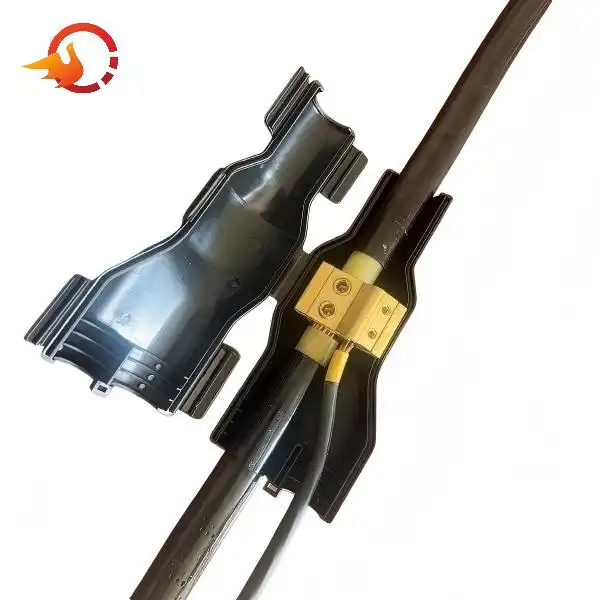
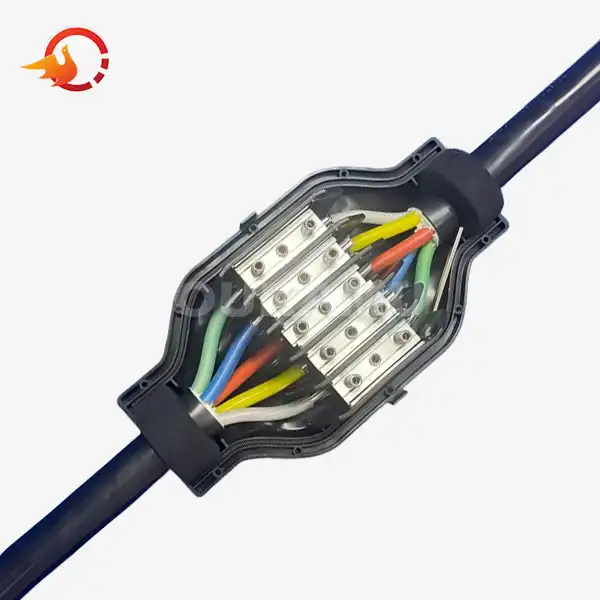
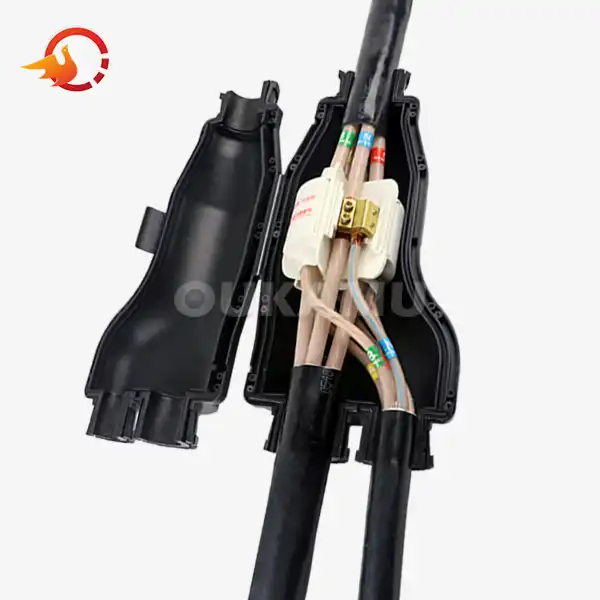
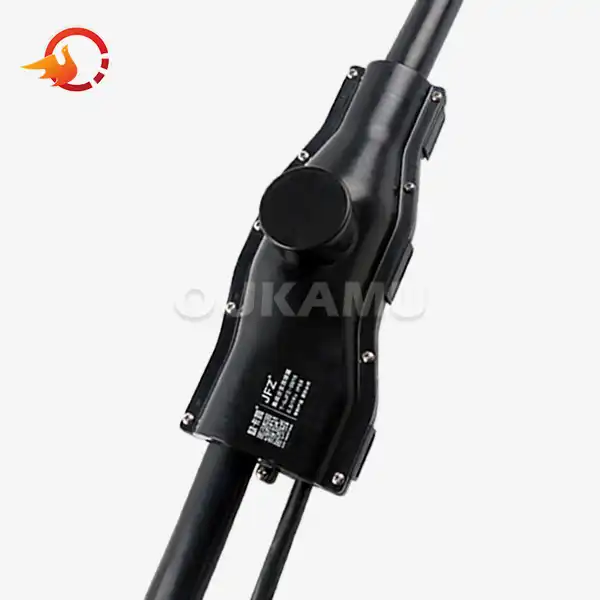
Oukamu Electric specializes in comprehensive cable connection solutions engineered specifically for demanding industrial environments including mining operations, petrochemical facilities, steel production plants, and cement manufacturing sites. Our cable branch connectors deliver on-site installation flexibility that traditional prefabricated systems cannot match, allowing electrical teams to position branch connections precisely where needed without wasting cable or accommodating fixed factory-determined branch locations.
Having specialized in branch cable technology for 20 years, we understand the operational pressures driving your procurement decisions—minimizing unplanned downtime, maintaining regulatory compliance, and controlling total ownership costs while ensuring worker safety. For inquiries, technical support, or customized project consultations, reach out to us at info@okmbranchcable.com, and our engineering team will respond with tailored solutions for your specific application needs.
References
1. National Electrical Manufacturers Association. (2021). Cable Systems and Components: Design and Installation Guidelines.
2. IEEE Standards Association. (2020). IEEE Standard for Power Cable Systems in Industrial and Commercial Applications (IEEE Std 525-2020).
3. International Electrotechnical Commission. (2021). Power Cables with Extruded Insulation and Their Accessories for Rated Voltages from 1 kV up to 30 kV (IEC 60502).
4. British Standards Institution. (2019). Cables for Electrical Installations: Specification for Armoured Cables (BS 5467:2016+A1:2019).
5. Underwriters Laboratories. (2022). Standard for Metal-Clad Cables (UL 1569).
6. Occupational Safety and Health Administration. (2023). Electrical Safety Standards: Cable and Wiring Methods (29 CFR 1910.305).