

_1790150425011.webp)
Low Voltage Branch Cable vs Standard Power Cable






 2026-09-28 11:36:01
View:389
2026-09-28 11:36:01
View:389When comparing a low voltage branch cable with a standard power cable, the core difference lies in purpose and installation method. A low voltage branch cable allows electrical distribution branches to split off from a main trunk cable — at any point, without cutting the main conductor. Standard power cables, by contrast, carry current from source to load along a single continuous path. For procurement professionals managing large-scale infrastructure projects such as metro stations, hospitals, and tunnels, choosing between these two cable types directly affects project cost, installation speed, and long-term safety compliance.

Understanding Low Voltage Branch Cable and Standard Power Cable
It's helpful to know what each of these two types of cables does on a job site before comparing them.
What Is a Low Voltage Branch Cable?
A low voltage branch cable is a type of distribution cable that is made to make T-junction links from a main cable to sub-circuits. It can handle voltages of up to 0.6/1kV. Copper or metal is usually used for the conductor, and XLPE or PVC is used for the insulator. These cables help with branch circuit wiring in large commercial buildings, underground stations, and buildings with more than one floor where more than one load point needs to be fed from a single main trunk.
What Is a Standard Power Cable?
A normal power cable sends electricity along a single, uninterrupted path from one endpoint to the other, usually from a distribution panel to a terminal load. In addition to being available in a wide voltage range, it is built to carry a lot of current and last a long time. Standard power cables are the standard choice for backbone power transfer in most industrial setups because they are required by IEC 60502-1 and similar national standards.
Key Technical Specifications at a Glance
| Parameter | Low Voltage Branch Cable | Standard Power Cable |
|---|---|---|
| Rated Voltage | 0.6/1kV | 0.6/1kV to 35kV+ |
| Conductor | Copper / Aluminum | Copper / Aluminum |
| Insulation | XLPE / PVC | XLPE / PVC / Rubber |
| Main Cable Range | 35–95mm² | Varies by application |
| Branch Cable Range | 16–70mm² | N/A |
| Temperature Range | -40°C to +90°C | Varies |
| Standard Compliance | GB/T 14048.7-2016, IEC 60332 | IEC 60502-1 |
Key Differences Between Low Voltage Branch Cable and Standard Power Cable
There are structural and functional differences between these two types of cables that go beyond their voltage ratings. This helps buying teams avoid making mistakes with specifications that cost a lot of money.
Installation Method
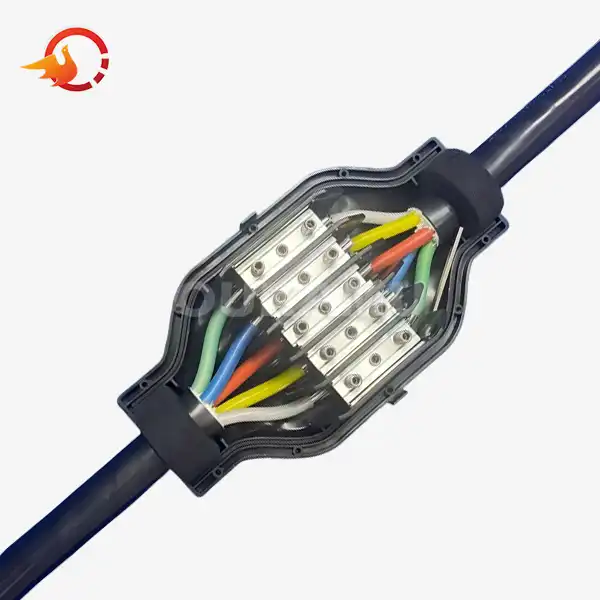
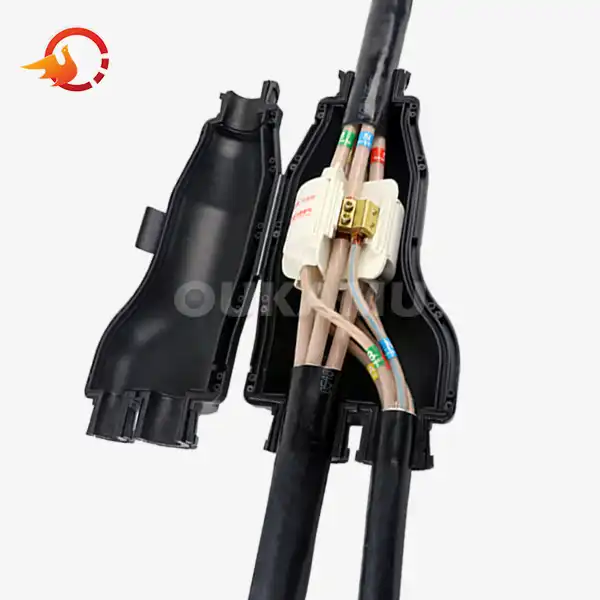
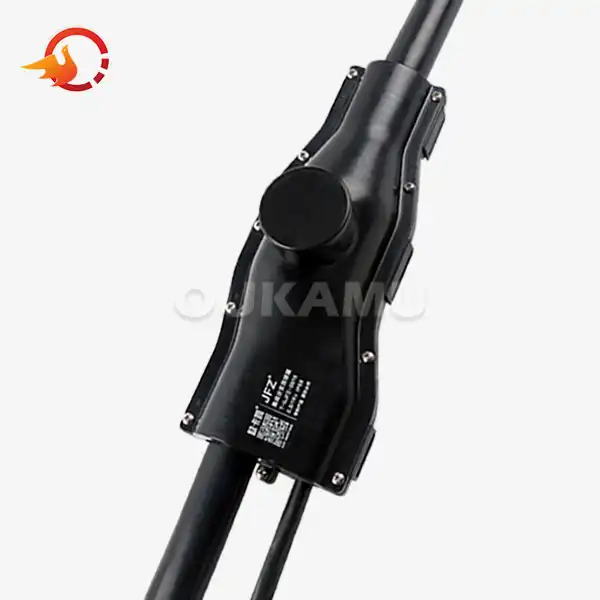
When a branch circuit is needed, the main wire of a standard power line has to be cut and re-terminated. This adds to the work that needs to be done, wastes cables, and creates connection points that can fail over time. A low voltage branch cable joint, like the Oukamu ZR-JFZ-95/70, can connect to the main wire directly and in any position. There's no need to cut or reserve any cable length at the branch point.

Construction and Flexibility
Branch cable joints are made around a small, built-in T-connector housing that can hold both the main trunk cable and the branch wire that is leaving at the same time. This design makes it easy to install while taking up little room, which is important for projects like metro and airports that use cable trays, conduit bridges, and narrow shaft areas. Standard power cords have a simple, multi-core design that works best for straight routing. They are not made to split in the middle of a run.

Safety and Compliance
When it comes to fire safety in big public buildings, both types of cables must meet the rules. The ZR-JFZ-95/70 meets the requirements of IEC 60332, IEC 60502-1, and GB/T 14048.7-2016 for flame retardant, fire resistant, and waterproof protection all in one integrated assembly. To get the same level of protection at branch points, standard power cables need separate junction boxes and sealing accessories. This makes the final acceptance reviews more expensive and harder to do.
Choosing the Right Cable for Your Project: Practical Considerations
If you buy the wrong type of wire, you may have to pay a lot of money to fix it later. Here are the things that really matter on real construction sites.
Matching Cable Type to Application
In vertical distribution systems for high-rise buildings, subway station lighting circuits, hospital emergency power branches, and airport terminal power grids, low voltage branch cables are the recommended standard. There are dozens of branch tap points along a single main trunk cable in these settings. Being able to place each tap anywhere on the cable without having to cut it first saves a lot of time and material.
Standard power lines are still the best choice for motor link circuits, backbone feeder runs, and any other use where a straight path from one point to another can carry the full load without branching.

Total Cost of Ownership
When you look at the cost savings of branch cable joints over the course of a whole project, they become most clear. When you use the ZR-JFZ-95/70 instead of cut-and-rejoin, each branch point saves two to three meters of main cable. That's 100–150 meters of recovered cable value on a project with 50 branch points. There are also fewer hours of work and fewer accessory parts to check during acceptance.
Supplier Evaluation Criteria
When looking at wholesalers for either type of cable, buying managers should ask for the following things before they send out a purchase order:
- Reports from the national electrical testing center confirming that the product meets all standards
- GB/T 14048.7-2016 forms for branch cable joints that show they are compliant
- Project sources that are written down and show field uses at a similar scale
- On-site technical support for installation help and inspection after installation
These files immediately support the bid evaluation files that most EPC general contractors need.
Advanced Comparison and Technical Insights
Copper vs. Aluminum Conductors
Copper conductors have a lower resistance (1.72 × 10⁻⁸ Ω·m) than aluminum conductors (2.82 × 10⁻⁸ Ω·m). This makes copper the best material for precise distribution circuits that need to avoid voltage drop. When the cross-sections are the same, aluminum conductors weigh about a third less than copper conductors. This is important for large-scale cable tray setups in tunnels and rail projects. The ZR-JFZ-95/70 can handle both types of wire materials in the main cable range of 35 to 95 mm² and the branch cable range of 16 to 70 mm².
XLPE vs. PVC Insulation
XLPE insulation stays effective over a bigger temperature range (-40°C to +90°C) and is better at keeping water out than regular PVC. XLPE is the better long-term choice for installing things in tunnels and routing cables outside. PVC insulation is still a good choice for safe indoor spaces where the temperature stays in a reasonable range and is not too expensive. Choosing the right insulation for the site environment has a direct effect on how long the system will last.
Conductor and Insulation Comparison Table
| Feature | XLPE Insulation | PVC Insulation |
|---|---|---|
| Temperature Range | -40°C to +90°C | -15°C to +70°C |
| Moisture Resistance | High | Moderate |
| Flexibility | Moderate | High |
| Cost | Higher | Lower |
| Preferred Use | Tunnels, outdoor, wet areas | Protected indoor spaces |

Project Case Reference
The team installing a metro station in a provincial capital city used Oukamu low voltage branch cable joints on 120 branch tap points in the low voltage distribution system of the station. The original plan for the project gave 18 working days for installing the branch circuit.
The same work was done in 11 working days because the team switched from the usual cut-and-terminate method to on-site T-connection joints. The electrical boss for the project stated that all branch points passed the first check for fire resistance and insulation resistance, and that no work needed to be done again during the acceptance review.

Procurement Guide and Buying Recommendations for B2B Clients
Verifying Vendor Credentials
Before adding any low voltage branch cable joint to the list of allowed vendors, you should get test results from an electrical or fire-rated materials testing center that is nationally recognized. These reports should specifically talk about GB/T 14048.7-2016 for the Chinese market. IEC 60332 and IEC 60502-1 compliance certificates are the usual starting points for foreign projects. Oukamu goods come with both domestic and foreign compliance paperwork, which helps EPC general contractors prepare bid files.
Bulk Order and Logistics Planning
Before giving out the supply deal for a big job, make sure you know how long it will take to get large amounts of something. Oukamu can work with custom specs and can coordinate processes around the world to make sure projects are finished on time. When planning deliveries, procurement managers should think about when the deliveries will happen in relation to the installation milestones. This is especially important for metro and airport projects where delays in electrical materials can affect the critical path schedule.
After-Sales Technical Support
The ability to get expert help on-site is something that sets differentiating factors apart that experienced buying teams carefully consider. Oukamu gives direct technical support to installation crews, such as advice on the right amount of crimping torque, how to seal waterproof gaps, and how to get ready for an inspection. This cuts down on the chance of branch point failures during final acceptance and speeds up the commissioning process overall.
Conclusion
Whether you use a standard power line or a low voltage branch cable system relies on how your project's power is distributed. Branch cable joints are better than traditional cut-and-terminate ways for multi-branch low voltage lines in high-rise buildings, metro stops, hospitals, and tunnels. They are also more cost-effective.
The Oukamu ZR-JFZ-95/70 is made just for these uses; it meets GB/T 14048.7-2016 and other international fire safety standards, and there's no need to cut the main cable at any branch points. For procurement teams in charge of large EPC projects, choosing the right connection method during the design phase saves money on rework and improves the chances of acceptance.
FAQ
What is the main advantage of a branch cable joint over a standard cable splice?
A low voltage branch cable joint joins a main cable to a branch cable without cutting the main cable. This keeps the trunk circuit's electrical continuity, speeds up installation, and gets rid of the risk of splice-point failure that comes with traditional cut-and-rejoin methods. This means that both labor and material costs will go down for big projects with a lot of branch points.
Is the ZR-JFZ-95/70 suitable for outdoor and underground tunnel applications?
Yes. The waterproof and flame-retardant features of the ZR-JFZ-95/70 make it suitable for use in wet, underground, or outdoor wire handling situations. Its XLPE insulation choice keeps working well from -40°C to +90°C, which is the temperature range that most tunnel and outdoor infrastructure projects need to work in.
What compliance documents should I request from a branch cable joint supplier?
Request a test report from an electrical testing center that is recognized by the government that says the product meets GB/T 14048.7-2016 standards. The report should also include IEC 60332 and IEC 60502-1 fire resistance certificates. These papers are usually needed to qualify as a supplier and send in a bid file for EPC general contractor projects.
Can the branch position be adjusted after the main cable is already installed?
Yes. The branch tap point can be placed anywhere along the installed main cable, which is a useful feature of on-site T-connection technology. This means that branch spacing doesn't have to be planned ahead of time during planning. This lets installation teams adapt to changes in route on the job site without wasting cables.
Partner With Oukamu for Your Next Branch Cable Project
The ZR-JFZ-95/70 shows how much Oukamu has learned about branch cable joint technology over the past 20 years. We are a reliable company that makes low voltage branch cables. To meet the deadlines for EPC projects, we offer technical support on-site, documented compliance, and the ability to supply in bulk. You can find full technical specs at okmbranchcable.com, or you can email our team at info@okmbranchcable.com to talk about your project needs and ask for a trial.
References
1. International Electrotechnical Commission. IEC 60502-1: Power Cables with Extruded Insulation and Their Accessories for Rated Voltages from 1 kV up to 30 kV. IEC, 2004.
2. International Electrotechnical Commission. IEC 60332-1: Tests on Electric and Optical Fibre Cables Under Fire Conditions. IEC, 2004.
3. Standardization Administration of China. GB/T 14048.7-2016: Low-Voltage Switchgear and Controlgear — Part 7: Ancillary Equipment. SAC, 2016.
4. Institution of Engineering and Technology. Wiring Regulations: BS 7671 Requirements for Electrical Installations. IET, 2018.
5. Anders, George J. Rating of Electric Power Cables in Unfavorable Thermal Environment. IEEE Press / Wiley, 2005.
6. Thue, William A. Electrical Power Cable Engineering. 3rd ed. CRC Press, 2012.