

_1790150425011.webp)
Armoured Cable Connector Selection Tips for Engineers Guide Now






 2026-08-28 11:15:54
View:389
2026-08-28 11:15:54
View:389Choosing the right armoured cable connector can make or break your electrical installation project. An Armoured Cable Connector is the critical bridge between cable protection and system reliability, providing mechanical strength, environmental resistance, and electrical safety across industrial, commercial, and infrastructure applications. With dozens of connector types, materials, and specifications available, engineers need a clear, practical framework to make informed decisions quickly. This guide delivers actionable insights to help you select connectors that meet safety standards, control costs, and ensure long-term performance in demanding environments.

Understanding Armoured Cable Connectors: Types, Uses, and Benefits
What Armoured Cable Connectors Actually Do
Armoured Cable Connectors use steel wire armour (SWA) or aluminium wire armour (AWA) to secure and end cables. The outer layer fits perfectly with electrical cabinets, junction boxes, and equipment housings. Unlike regular cable glands that are made for cables that aren't armoured, these special connections grip and ground the metal armour, which keeps mechanical stress from moving to the inner conductors. This design keeps the integrity of the cable even when it is subjected to the vibrations, impacts, or pulling forces that are common in industrial settings.
Core Connector Types You'll Encounter
The connector market offers several distinct configurations tailored to specific installation needs:
- Straight and Right-Angle Connectors: Straight connections work well in normal panel entries where there is room for straight wire routing. When cables need to turn sharply after entering, or when the enclosure is small, the right-angle versions save valuable space. There are single-compression and double-compression versions of both types. Double-compression versions fit better and relieve strain better.
- Waterproof and Flameproof Variants: Waterproof connectors with an IP rating (usually between IP66 and IP68) can be used for outdoor installations, underground runs, and places where they will be washed down. Flameproof connectors are approved by ATEX or IECEx for use in chemical plants, refineries, and mines that have explosive atmospheres. There may be sparks or flames inside the connector body of these specialized units.
- Material Choices Matter: Brass connectors are reasonably priced and have good transmission and rust protection. Stainless steel versions can handle being exposed to harsh chemicals and high temperatures. Nickel-plated steel makes it last longer while keeping the price low. Composite joints save weight and don't rust in places that aren't dangerous.
Primary Application Environments
A lot of underground power distribution depends on armoured cable systems with waterproof connectors that keep the cables together even when the ground moves or the soil gets wet. Connectors that can handle being handled roughly, being put in place temporarily, and being exposed to cement dust or water are needed on construction sites.
In factories, flameproof connectors are used near flammable materials, and standard IP-rated units are used in general manufacturing areas. For long service life, municipal infrastructure projects like street lights, traffic systems, and public buildings need connections that are both durable and cost-effective.
Key Benefits Engineers Should Recognize
If you choose the right connectors, you can extend the life of your cable system by stopping moisture from getting in, which is the main reason why insulation fails. The mechanical grip on armour keeps the conductors from getting worn out from movement or sound. Effective earthing through metal connector bodies is necessary for electrical safety because it lowers the risk of shock and helps protective devices work. Following national electrical codes and foreign standards keeps projects safe from liability and makes sure that insurance coverage is legal.
How to Choose the Right Armoured Cable Connector: Criteria and Best Practices
Environmental Assessment Comes Before Everything
Before you choose an Armoured Cable Connector, you should honestly look at the installation environment. For climate-controlled rooms inside, basic moisture protection is needed, while IP65 minimum grades are needed for outdoor use. Installations that are buried need to be protected against constant submersion with IP67 or IP68.
Chemical plants, food processing plants, or sites near the coast may need to be built out of stainless steel to protect against acidic atmospheres. Material thermal tolerances are set by extreme temperatures, like when it's freezing outside or when there are high-heat processes going on in factories.
Sizing Accuracy Prevents Costly Mistakes
Three important measures determine the size of a connector: the outer diameter of the cable (including armour), the diameter of the armour wire, and the diameter of the inner core. When connectors are too big, they don't grip properly, letting water in and lowering pressure relief. Units that are too small won't be able to hold the wire at all, or they will need to be installed with risky force. Measure your real wire, because maker specs and shipped goods don't always match up. When installing more than one cable, you should decide whether individual connectors or multi-cable glands work better for your layout.
Material Selection Balances Performance and Budget
Here's how common materials stack up for different scenarios: Brass connectors are good for normal installs inside and light use outside because they are affordable and don't rust. Nickel-plated brass lasts longer outside at a small extra cost, making it perfect for projects that need to stay within a budget and don't need to be used in harsh settings. Stainless steel is worth the extra cost in chemical plants, marine environments, food processing plants, and other places where corrosion could affect the long-term dependability of the structure.
Aluminum and composite connectors are used for applications that need to be light, like cable runs that go overhead or temporary installations where corrosion is not a big problem. Each choice of materials has a different effect on the total cost of the job; although stainless steel connectors are 40–60% more expensive than brass ones, they often have a better lifetime value in harsh settings because they require less upkeep and last longer.
Certification Requirements You Cannot Ignore
Safety certifications protect your project legally and in terms of how it works. IP (Ingress Protection) ratings show how resistant something is to dust and water. IP65 ratings cover strong water jets, IP66 ratings add submersion resistance, and IP68 ratings guarantee continuous underwater operation. ATEX and IECEx certifications show that a product can't explode in dangerous places. UL and CSA listings show that a product meets North American electrical safety standards. European regulatory standards are confirmed by the CE mark. Always make sure that the licenses you get meet the standards of your area and the project's needs.
Connector Configuration Trade-offs
When there is enough room, straight connectors are cheaper and easier to install. Angled connectors fix problems with tight space and lower the stress on wires entering shallow enclosures. When exact cable route is only clear during installation, rotating glands make it possible to change the entry angle in the field after the initial installation. Double-compression designs are 15–25% more expensive than single-compression designs, but they lock better and are less likely to vibrate, so the extra cost is worth it in important situations.
Installation Guide: Step-by-Step Tips for Engineers
Pre-Installation Preparation Sets Success
Before you start, make sure you have the right tools. You will need cable strippers made for Armoured Cable Connector use, armour cutting shears or a junior hacksaw, the right wrenches or spanners for the type of connector you have, and torque wrenches for tough jobs. Check that your connection fits the wire specifications. Finding mistakes early on will save you hours of work later on. Check the project specifications and local electrical codes to make sure the installation methods meet all the needs. Make sure there is enough light and access to the workspace, especially for pieces that are high up or in a small room.
Precise Cable Preparation Technique
Carefully remove the outer sheath to reveal the armour wires without damaging them. This process usually takes 50 to 70 mm, depending on the size of the connector. Evenly fold back the armour wires and look for broken strands that could affect their ability to ground and stay strong. As directed by the connector maker, remove the required length of inner bedding to reveal the wires. Rough cuts or broken armour wires make it hard for the connector to seal properly and work properly. Before moving on, clean any dirt or moisture off of the uncovered wire parts.
Proper Connector Assembly Procedure
Slide the backnut and sealing parts onto the cable in the right order. To reverse parts, the whole assembly has to be taken apart. Place the body of the connector so that the cone or compression ring engages all of the armour wires equally. To avoid cross-threading, thread the backnut while holding the connection body in place.
Tighten the backnut to the required pressure. If you don't tighten it enough, water can get in, and if you tighten it too much, you can damage the seals or crack the connector bodies. Usually, metal connectors need 25 to 40 Nm, but the exact requirements depend on the size and design of the connector.
Verification and Testing Standards
Once everything is put together, check the connection carefully for gaps, misaligned parts, or armour wires that are sticking out. To make sure the armour is properly grounded, test the consistency between it and the ground. Testing with a megger shows that the insulation resistance meets the code. For upkeep records, write down information about the installation, such as the connector type, the date it was done, and the test results. In important situations, you might want to use thermographic imaging after powering up to find links with high resistance that are causing heat to build up.
Common Installation Errors to Avoid
Most connector failures happen because people are in a hurry to prepare the cables. Not enough armour contact stops good grounding. When armour lines are damaged, they cause stress points that break when the armour is vibrated. If sealing washers are missing or in the wrong place, water can get in. Connections that are cross-threaded or not torqued properly leak or break mechanically. By taking your time during installation, you can avoid costly returns and system breakdowns.
Procuring Armoured Cable Connectors: What Buyers Need to Know
Sourcing Strategy for Reliability
Well-known brands like Thomas & Betts, HellermannTyton, 3M, Eaton, and ABB offer tested Armoured Cable Connector designs that come with a lot of approval paperwork. Regional suppliers can often produce faster and offer local expert help. They can also keep quality high by producing only what is allowed by law. Dual-sourcing methods lower supply chain risk for big projects without giving up uniformity. Not just the price per unit, but also the suppliers' availability of products, quality of technical support, certification paperwork, and service after the sale should be taken into account.
Understanding Purchase Quantities and Economics
Minimum order quantities (MOQ) are very different. Major distributors may sell single units, but if you buy directly from the manufacturer, you usually need to buy at least 50 to 500 pieces, depending on the type of connector. Prices usually go down after 50, 100, and 500 units, and as the number of units sold goes up, savings range from 10 to 35%. Lead times are between 2 and 4 weeks for stock items and between 8 and 12 weeks for special orders or custom configurations. It's best to start planning your purchases early, especially for big jobs or links that are hard to find.
Essential Purchasing Considerations
The following table shows the most important reasons for choosing between different types of suppliers:
| Supplier Type | Typical MOQ | Lead Time | Price Level | Technical Support | Best For |
|---|---|---|---|---|---|
| Major Distributors | 1-10 units | 2–7 days | Retail | Limited | Small projects, fast needs |
| Regional Wholesalers | 25-50 units | 1–3 weeks | Moderate discount | Good | Medium projects |
| Direct Manufacturers | 100-500 units | 4–12 weeks | Maximum discount | Extensive | Large projects, custom specs |
| Online Platforms | 1-25 units | 3–14 days | Variable | Minimal | Emergency purchases |
Certification Verification Process
Before you buy, make sure you have all the certification paperwork you need, such as test results, compliance certificates, and material specs. Please check the validity of the certification; outdated licenses are a sign of noncompliance. When possible, compare certification numbers with records kept by the granting body. For projects that need specific approvals, send paperwork to the people in charge of approvals early on in the procurement process to find problems before you buy a lot of things. Fake connectors are very dangerous, so only buy from reputable companies with supply chains that can be tracked.
Real-World Procurement Case
A recent project to improve street lights in the northeastern US needed 1,200 metal connectors with an IP67 rating for terminating cables underground. The buying group looked at three suppliers: quotes from a direct manufacturer for $12.50 per unit with a 10-week lead time, quotes from a regional distributor for $16.80 per unit with a 3-week delivery time, and quotes from an emergency stockholder for $22.50 per unit with immediate shipment.
It was possible for early-start sites to keep their schedules flexible by ordering 800 units directly from the maker and 400 units through a distributor. This way, the project was able to get a combined cost of $14.20 per unit. Compared to all-distributor buying, this approach saved about $3,100 and kept the project from being held up by reliance on a single manufacturer.
Armoured Cable Connector Comparison and Market Insights
Performance Benchmarks Across Connector Types
Performance traits change depending on the type of Armoured Cable Connector used. Standard single-compression brass connections can be used for most general-purpose tasks. They have an IP65 rating, can last 25 years in normal conditions, and can handle temperatures from -20°C to +80°C. With double-compression stainless steel units, these specs are increased to IP68, 35+ years of service in harsh conditions, and operation from -40°C to +120°C. Flameproof connectors make it easier to contain explosions, but they make installation 150–200% harder and cost 150–200% more than standard units.
Emerging Design Trends
The connection market is still changing, and there have been some big changes recently. Pre-assembled plugs, which cost more, cut installation time by 40 to 60% and cut down on mistakes in the field. Tool-free designs don't need any special tools to be installed, which is helpful for making changes in the field or fixing things quickly.
Hybrid connections can hold both armoured and non-armoured wires in a single unit, which makes inventory management easier. Better protection against the environment thanks to new elastomer materials makes things last longer outside in harsh conditions. These new ideas solve real problems that come up during installation, but they also make it harder to decide between original cost and ongoing value.
Market Demand Patterns
Connectors that are resistant to flames and chemicals are always in high demand as factories grow. A lot of outdoor-rated plugs are needed for renewable energy projects, like solar farms and wind sites. The building of data centers increases the need for reliable connectors in controlled environments. Modernizing infrastructure projects lead to large sales of standard connections, which leads to price competition and the availability of large quantities. Knowing these trends helps procurement managers plan ahead for problems with availability and changes in prices.
Decision Framework for Buyers
Match the connectors you choose to your list of priorities. Premium flameproof or double-compression joints are worth the extra cost for projects that put a lot of emphasis on safety and dependability in important systems. Standard plugs that are easy to maintain are fine for setups that are cost-conscious and don't want to take too many risks.
When projects have tight deadlines, pre-assembled or tool-free designs that cut down on installation work are helpful. Overspecification is necessary to keep failure-related excavation or demolition costs as low as possible in situations where future access will be limited, like underground installations or building systems that are built into the ground.
Comparative Analysis of Popular Connector Families:
| Connector Category | Typical IP Rating | Material Options | Relative Cost | Installation Time | Ideal Applications |
|---|---|---|---|---|---|
| Standard Single-Compression | IP65 | Brass, Nickel-plated brass | Baseline (1.0x) | 8-12 minutes | Indoor industrial, commercial buildings |
| Double-Compression | IP66-IP68 | Brass, Stainless steel | 1.2-1.4x | 10-15 minutes | Outdoor, underground, high-vibration |
| Flameproof (ATEX/IECEx) | IP66 | Brass, Stainless steel | 2.0-2.5x | 15-25 minutes | Hazardous locations, chemical plants |
| Pre-assembled Quick-Connect | IP65-IP67 | Various | 1.6-2.0x | 3-5 minutes | Fast installation, labor-constrained |
Xi'an Oukamu's Innovative Approach
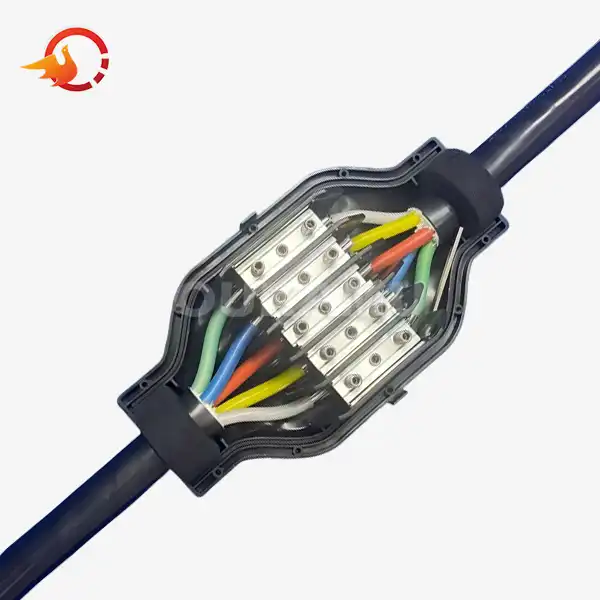
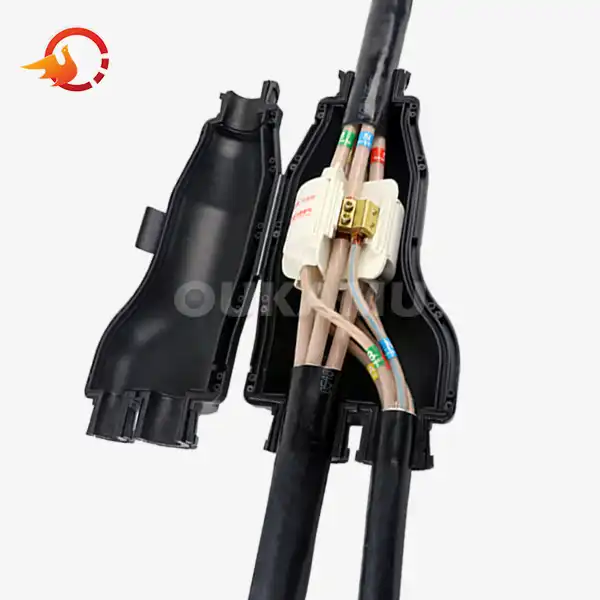
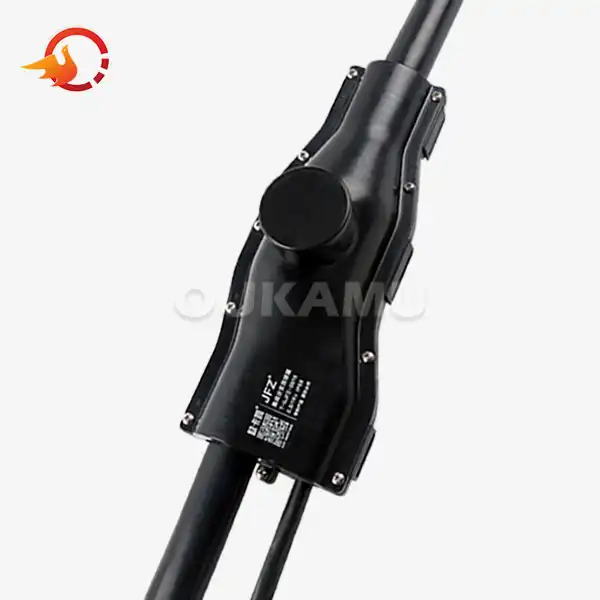
Xi'an Oukamu Electric Co., Ltd. addresses a complementary challenge—flexible branch connections directly on steel wire armoured cables—while conventional connectors concentrate on cable termination. Engineers can use our cable branch connection technology to set up safe branch points along trunk lines in any place, without having to cut the main line.
This feature is especially helpful for complicated installations like multi-story buildings, factories with spread-out equipment, and infrastructure projects where the exact branch sites are found during the installation phase rather than the planning phase. According to GB/T 14048.7-2016 standards, the system can handle main wires from 95mm² to 240mm² and branch cables from 6mm² to 70mm². It can also handle 0.6/1kV uses.
•Product Performance
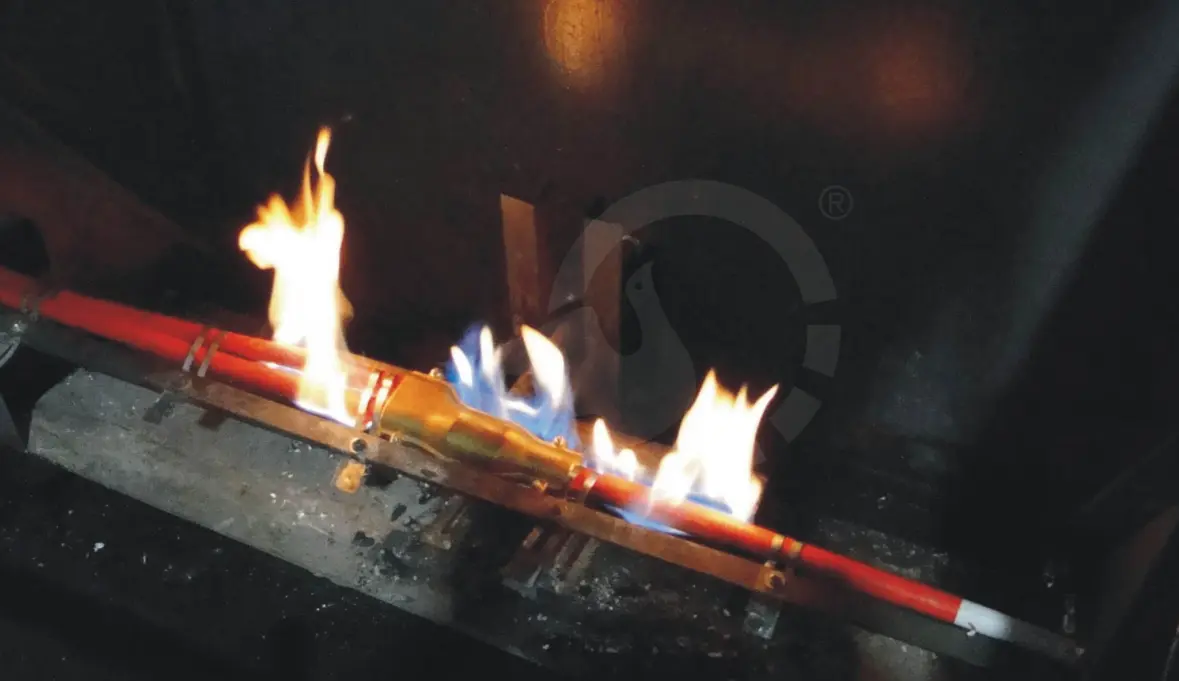
Fire Resistance Performance:
•Circuit Integrity C: After being subjected to fire (950°C–1000°C) for 180 minutes, the circuit remains intact.
•Circuit Integrity W: After being subjected to fire (650°C–700°C) for 15 minutes, followed by water spray and continued fire exposure for another 15 minutes, the circuit remains intact.
• Circuit Integrity Z: After being subjected to fire (950°C–1000°C) and mechanical vibration for 15 minutes, the circuit remains intact.
•Protection Rating: IP65 (prevents ingress of foreign objects, dust, rain, and jet water; suitable for non-immersion applications).
Insulation Resistance: At 90% humidity, test voltage 1kV, phase-to-phase insulation resistance > 10,000MΩ.
Withstand Voltage: At 90% humidity, applied voltage 3.5kV for 5 minutes, no phase-to-phase breakdown.
Complies with the requirements of BS6387:2013 *"Test method for resistance to fire of cables required to maintain circuit integrity under fire conditions"* and Q/OKM01-2018 *"Integrated branch devices with rated voltage 0.6/1kV"* for circuit integrity, conductor continuity, thermal cycling tests, and other standard requirements.
Certified and tested qualified by the National Engineering Laboratory for High-Speed Railway Construction Technology, the National Center for Quality Supervision and Testing of Fire Building Materials, the National Quality Supervision and Testing Center for Wire and Cable, and Oukamu Electric Co., Ltd.
Conclusion
When choosing Armoured Cable Connectors, you need to think about the technical requirements, the needs of the surroundings, the need to follow the rules, and the cost of the project. When engineers take the time to learn about the different types of connectors, the properties of the materials used, and the certification requirements, they can make decisions that improve the reliability of a system while keeping costs low.
Using the right installation method will protect your connector investment by stopping water from getting in and stopping mechanical failures that cost a lot of money in system downtime. As a procurement manager, you can make your supply chain more efficient by knowing what your suppliers can do and when to buy things. The connector market is always changing with new products that make installation easier and increase the service life of connectors. Staying up to date on these changes will help you complete successful electrical projects.
FAQ
What safety standards should I verify for armoured cable connectors?
Engineers should make sure that Armoured Cable Connectors have the right IP ratings for the environment (at least IP65 for outdoor use, IP67–IP68 for use underground or submerged). Check to see if the work complies with local electrical codes, like the NEC in North America or the IEC standards around the world. Installations in dangerous places need ATEX (Europe), IECEx (international), or the right state licenses. Listings by UL or CSA give North American projects extra confidence. Before choosing or buying connectors for important applications, you should always ask for proof of certification and make sure the certificate is still valid.
Can armoured cable connectors be reused after removal?
Use of connections again depends on their form and state. Compression connectors that have been used once and have sealing elements that are deformed should not be used again because the weak seals let water in and make the mechanical grip less effective.
If the connecting body is still in good shape and new seals are put on, reusable gland designs with changeable sealing parts can be put back in place. Before using it again, you should always check the threads, tension parts, and body structure. For important tasks or installations that need to be safe, replacing old connectors with new ones is the safest option because it gets rid of the risk of failure caused by reuse.
How do I ensure accurate connector sizing?
Use calipers to measure the real cable outer diameter, including the armour. Don't just rely on the cable specs, as manufacturing errors can lead to differences. Check both the armour wire diameter and the core diameter. Compare these measures to the connection's specs to make sure the cable diameter is within the range given by the connector.
When measurements get close to the limits of a size, choose the next larger connector size. For big jobs, buy one connector to make sure it fits right before buying a bunch of them. Correct sizing avoids problems during installation and guarantees good sealing and mechanical performance for the entire life of the connector.
Partner with Oukamu for Advanced Cable Connection Solutions
When your project needs more than just a standard termination—when you need branch connections that can be changed to fit the needs of the site while still being safe and reliable—Xi'an Oukamu Electric Co., Ltd. has options that have been used before. Because we've been experts in cable branch Armoured Cable Connector technology for 20 years, we can help distributors, electrical contractors, and procurement managers who are looking for new, low-cost cable connection systems.
We offer the technical know-how and high-quality manufacturing that your business needs, whether you're restocking your electrical supply company, putting together a list of parts for a big infrastructure project, or looking for dependable products that set your line apart.Our cable branch links work perfectly with 0.6/1kV armoured cable systems, so you don't have to cut the main trunk lines to make safe branch connections anywhere along the cable run.
Compared to traditional junction box ways, this flexibility cuts installation time and wire waste by a huge amount (saving 2 to 3 meters per connection point). The small, weatherproof design can be put in cable bridges, pipe systems, or other open areas. It comes with full insulation, flame retardancy, and rust resistance. We've designed reusable connections that meet the requirements of GB/T 14048.7-2016 and offer great value for money for a wide range of projects, from commercial buildings to industrial facilities.
Get in touch with our technical team to talk about the needs of your specific application. We support flexible order quantities from initial trials through full-scale project deployment as an established supplier with comprehensive manufacturing capabilities. If you want to see our full range of products, ask for technical details, or get project-specific quotes that fit your budget and schedule, please email us at info@okmbranchcable.com or visit okmbranchcable.com.
References
1. National Electrical Manufacturers Association (NEMA). Standards Publication for Industrial Control and Systems: General Requirements, Standards, and Safety Guidelines. NEMA Standards Publication ICS 1-2020, Rosslyn, VA, 2020.
2. International Electrotechnical Commission. Low-Voltage Switchgear and Controlgear – Part 7: Ancillary Equipment – Cable Connection Components. IEC 60947-7-1:2009+AMD1:2021, Geneva, Switzerland.
3. Copper Development Association. Electrical Installation Handbook: Protection Against Electric Shock and Fire. Fourth Edition, CDA Publication 198, Hemel Hempstead, UK, 2018.
4. British Standards Institution. Code of Practice for Protection of Structures Against Water from the Ground. BS 8102:2009, London, United Kingdom, 2009.
5. Institute of Electrical and Electronics Engineers. IEEE Recommended Practice for Cable Installation in Industrial and Commercial Buildings. IEEE Standard 1242-2016, New York, NY, 2016.
6. European Committee for Electrotechnical Standardization. Cable Management Systems – Particular Requirements for Cable Glands and Sealing Systems. EN 50262:1999+A1:2012, Brussels, Belgium, 2012.