

Electrical Cable Joint Connector vs Splice Kits: Which Is Best?






 2026-11-25 12:11:40
View:389
Job, not product, determines best decision. An electeical cable joint connector with approved insulation is suitable for low-voltage connections. Splice kits provide matching sealing, stress management, and shielding for underground, wet, or medium-voltage lines. A branch cable junction might leave a main cable uncut when tapping it. Compare the choices and see where Oukamu's ZR-JFZ-300/95 fits. The facts I offer assist purchasing managers and electrical contractors receive accurate quotations on the first inquiry.
Labor time matters on every commercial job, and a joint that fails inspection costs more than the part itself. Electrical contractors on offices, hospitals, and schools need joints that pass the first time. That is the lens I use throughout this guide.
What Is an Electrical Cable Joint Connector, and What Is a Splice Kit?
How an Electrical Cable Joint Connector Works
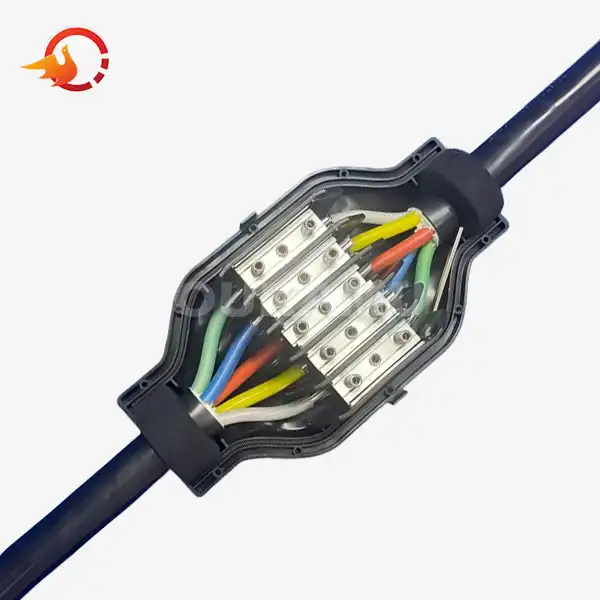
Current flows with minimal contact resistance via an electrical cable junction connection. Crimp, compression, mechanical, inline, and branch designs for copper, aluminium, or both are common. The connection makes metal-to-metal contact, but installers add tape, sleeves, or resin for insulation and moisture sealing. Stripping length, conductor cleanliness, and tool or torque are as important as the part since a properly crimped junction increases resistance and temperature under load. The IEC 61238-1-1 compression and mechanical connection test techniques provide purchasers a benchmark to request.
What a Splice Kit Adds
Splice kits have complete joining. Connectors, heat-shrink or cold-shrink sleeves, sealer, gel, glue, and printed instructions are typical. Medium-voltage kits include pieces for stress and grounding. Heat-shrink sleeves need a heat gun or torch, whereas cold-shrink sleeves are pre-expanded and tighten without heat. Kits with insulated cable junctions rated 2,500 V to 500,000 V must meet IEEE Std 404. A kit costs extra per joint and adds pieces, but it has factory-tested insulation.
Why the NEC Matters for Both
US electrical code (NFPA 70) establishes the standard. Section 110.14(B) requires splicing devices and insulation equal to the conductors or a designated insulator over every splice and junction. Copper and aluminium cannot share a terminal or splicing connection unless the device is recognised. These requirements apply to solo connectors with individual insulation or whole kits. Ask your local authorities what listings or proof it accepts before buying.
Key Differences and the Right Fit for Each Application
Installation, Insulation, and Total Cost
Unit cost is just half of the story for an electeical cable joint connector. A isolated connection costs less, but the team must insulate, seal, and examine it. A kit costs extra per joint but includes matching parts and instructions, reducing guessing. Labour accounts for a major portion of installation cost on many commercial works, thus include tools, torque control, instruction, evaluation, and rework in the purchase price. Opening a failing joint under a completed ceiling or riser costs more than the part. Compare choices by installed cost per connection, not quotation.
Dry, Low-Voltage Indoor Work
In dry, protected interior locations below 1 kV, such as office riser or school hallway, a suitably rated electrical cable joint connection with acceptable insulation typically works. Inspectors can view the junction without moisture. Start with the product label's conductor material, length range, and voltage rating. In hospitals and high-rise structures, flame-retardant / fire-resistant insulation and a test report for the cable type you install are required for fire safety.
Wet, Buried, and Medium-Voltage Runs
Direct-burial, outdoor, water, and medium-volt runs are risky. Stress control, shield continuity in and grounding are needed for medium-voltage junctions because water degrades insulation. A sealed splice kit constructed to IEEE Std 404 is better than a taped connection. Hybrid connectors with independent sealing systems can work, but seek written evidence that the provider tested them together. Ask for the IP rating that fits your site's exposure from IEC 60529.
How to Choose, Install, and Avoid Costly Errors
A Selection Checklist
Matching the outer diameter is insufficient. Start with circuit material, cross-sectional area, cores, insulation, and voltage. Include current load, ambient temperature, exposure to ultraviolet (UV chemicals, and fire requirements. Pick a joining technique your team can do well: crimp and compression need the proper die and tool, mechanical kinds torque control, and resins systems cure time. Before accepting a sample, get certifications and test reports and note its standards. A clear spec document lets the provider match a model without emails, speeding quotes.
Installation Steps That Prevent Callbacks
A clean method avoids most field issues. Check the model, cord, voltage, and tools. Turn off and lock the circuit. Strip the insulation to the specified length, clean the conductor, and shield any insulation layers. Install the connection with the required crimp or torque, then seal and insulate to eliminate gaps and moisture. Finally, check the joint, test continuity and insulating resistance, and record findings by location. Crews may reference NECA 1, the electrical construction standard for quality.
Mistakes That Fail Inspections
Multiple work site errors occur when installing an electeical cable joint connector. Crews choose a part by cable diameter, use an indoor-rated connection outside, or forego insulation restoration if continuity tests pass. Others underestimate torque, combine copper and aluminium without a connection, or under-crimp. Hot patches form from exposed strands and grime. Each error causes rework, inspection failure, or callback, which costs more than the proper component. A quick electrical foreman briefing utilising supplier instructions captures most of them.
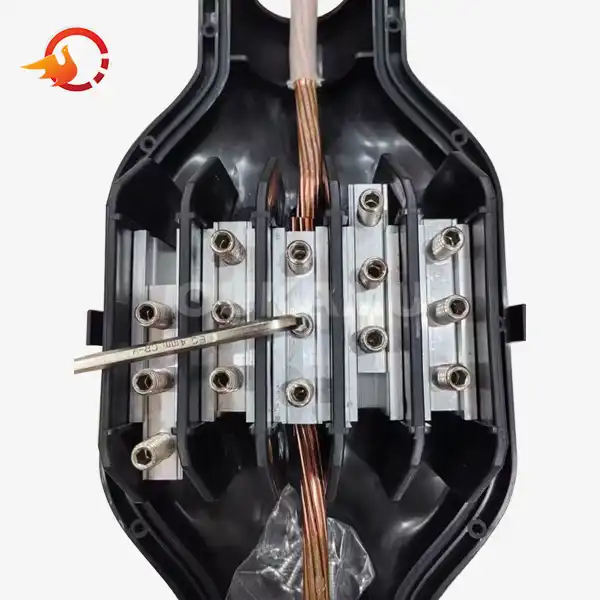
ZR-JFZ-300/95: A Branch Cable Joint for Low-Voltage Taps
Specifications at a Glance
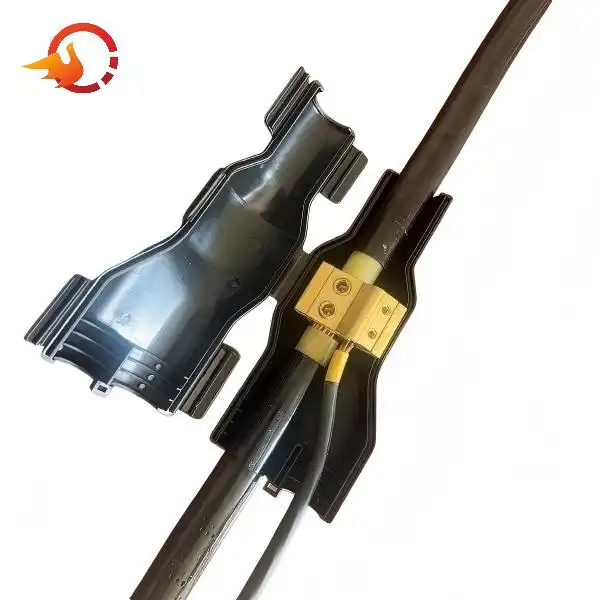
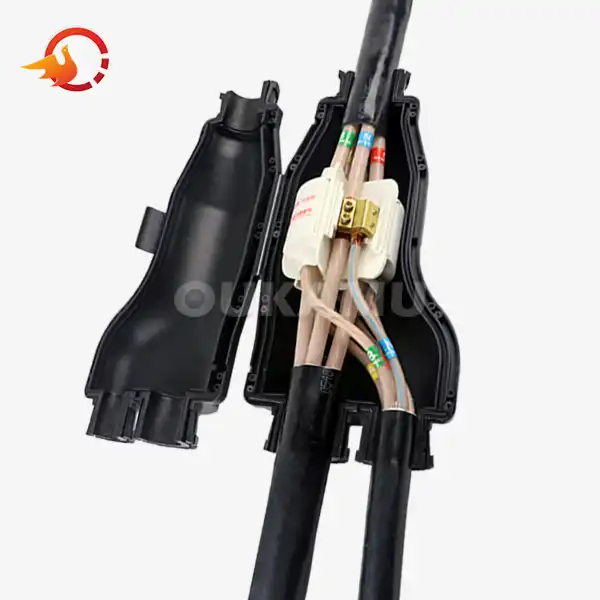
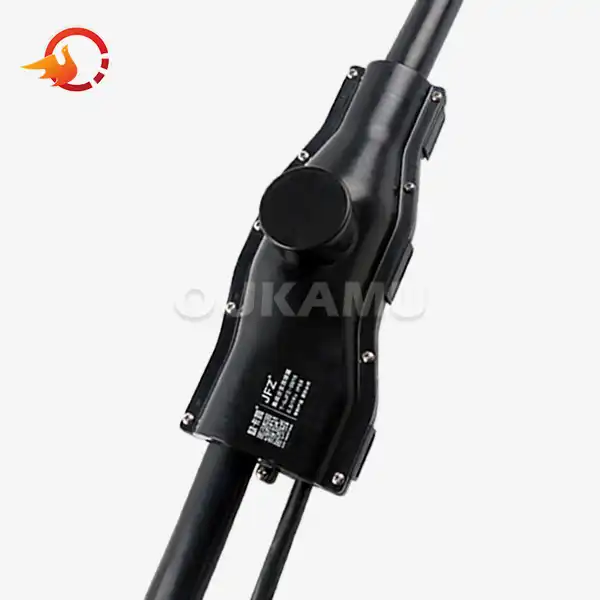
Oukamu has specialised in branch cable joints for 20 years. The ZR-JFZ-300/95 fits taps where the main cable stays whole, and the table lists its core data.
| Item | Specification |
|---|---|
| Model | ZR-JFZ-300/95 |
| Main cable | 120~300 mm |
| Branch cable | 10~95 mm |
| Rated voltage | 0.6/1 kV |
| Standards | GB/T 14048.7-2016 and international safety standards |
| Protection | Insulated, flame retardant, fire resistant, waterproof |
A wide size window lets one model cover many main and branch combinations within those ranges, which helps when site conditions change.
Features and a Site Example
The junction does not add a break point since the primary cable remains uncut. Main and branch cables join in a flame-retardant, fire-resistant insulated body with completely insulated and sealed branch cables. No reserved cable length is required, installation is flexible, and the small body fits open installation, cable trays, and bridges. Body is dustproof, anti-aging, and electrochemical corrosion-resistant. The product data claims it saves 2–3 meters of main wire, work, and time. Think hospital risers with 10 branch taps. By saving 2–3 meters every tap, the team saves 20–30 meters of main wire. That figure is arithmetic, not measured.
Where It Applies
The product data lists three cable families, shown below.
| Cable type | Application note |
|---|---|
| Low-voltage flame-retardant cables | Environments where fire safety is a priority |
| Fire-resistant cables | Installations that need extra protection against fire hazards |
| Mineral-insulated fire-resistant cables | Critical infrastructure where fire resistance and dependable operation are essential |
Match your cable type to the table, then send your main and branch sizes to confirm fit. This is a branch joint for taps, not an inline splice, so keep a splice kit in mind for joining two cable ends.
Supplier and Procurement Guide for B2B Buyers
What to Include in Your RFQ
A complete request earns a faster, more accurate quote. Here are the details I recommend sending:
- Cable data: Copper material, cross-sectional region outside diameter, core count, insulation type, and tap main and branch sizes. Please provide voltage and current load so the supplier can verify rating and model before pricing. Cable end photos or datasheets assist.
- Site conditions: Indoor or outdoor, moisture, temperature, chemical exposure, and fire needs like flame-retardant or fire-resistant cable. These details determine whether a solo connection, splice kit, or branch junction is appropriate and which test reports apply. Also note space constraints.
- Commercial terms: Quantity, delivery location, packing, certifications, and floor/phase schedule. Many commercial projects need phased orders, so establish the batch plan early and enquire how the supplier manages recurring orders and lead times. Set a written first-batch deadline.
Complete data for an electeical cable joint connector cuts back-and-forth emails and lowers the chance of ordering a model that does not match the cable on site.
How to Evaluate a Supplier
Check more than the pricing when choosing an electrical cable junction connection source. Discuss production, in-house testing, quality control, batch traceability, export expertise, and technical assistance. Ask for model-specific test results and compliance documentation with standards cited. Xi'an-based Oukamu designs, produces, and distributes cable connection equipment for construction, municipal, railroad, and highway projects. Ask all suppliers the same questions and compare written replies. A provider that addresses technical questions before the sale prefers to support the product thereafter.
Samples, Lead Times, and Documents
Before a phased order, compare a sample to your cable. Review the window size, sealing, and directions, and have your lead electrician evaluate the fit. Check sample availability, lead time, packing, and shipment to your site with the supplier, and seek formal compatibility confirmation for any hybrid configuration. Inspectors or the general contractor may request compliance papers from your project file. For US occupations, check with your local government whether the planned purpose needs extra listing. Okmbranchcable.com has product info.
Conclusion
Choose an electeical cable joint connector or splice kit based on application risk, not price. Connectors with certified insulation are suitable for dry, low-voltage operation. Matching insulation, sealing, and stress management at higher voltages are provided by a splice kit for buried, wet, and medium-voltage lines. Both ways, the NEC requires equipment to be labelled and insulated. Total installation cost—labor, testing, and rework—is a truer comparison than pricing. For low-voltage taps, the ZR-JFZ-300/95 branch junction spans 120–300 mm main and 10~95 mm branch cables at 0.6/1 kV without cutting the main cable. Cable data, test reports and a sample check prove the match.
FAQ
Can a branch joint replace a splice kit?
No. A splice kit joins two cable ends in line, while a branch joint such as the ZR-JFZ-300/95 taps a branch cable from an uncut main cable. Choose the type that matches the connection you need, then confirm the size range against your cables. Using the wrong type can force a main cable cut or leave a joint unsealed.
Which option suits wet or buried locations?
A sealed splice kit built to a published standard usually fits best. Ask for the IP rating, the test reports, and written confirmation that the supplier tested all parts together. The same rule applies if you pair a connector with a separate sealing system.
What documents should I request before ordering?
Request test reports and compliance documents for the exact model, voltage and size data, and installation instructions. For the ZR-JFZ-300/95, Oukamu cites compliance with GB/T 14048.7-2016 and international safety standards. Check with your local authority whether your project needs additional listing. Keep copies in your project file for inspectors.
Request an Electrical Cable Joint Connector Quote from Oukamu
Oukamu is an electrical cable joint connector manufacturer with 20 years in branch cable joints. Send your main cable size, branch cable size, voltage, and project quantity to info@okmbranchcable.com, and our team will match the ZR-JFZ-300/95 to your job. It saves 2–3 metres of main cable, labour, and time, with no need to cut the main cable. Visit okmbranchcable.com for details.
References
1. National Electrical Code (NFPA 70), 2023
2. IEEE Std 404, Standard for Extruded and Laminated Dielectric Shielded Cable Joints Rated 2500 V to 500 000 V, 2012
3. IEC 60529, Degrees of Protection Provided by Enclosures (IP Code), 2013
4. IEC 61238-1-1, Compression and Mechanical Connectors for Power Cables, 2018
5. NECA 1, Standard for Good Workmanship in Electrical Construction, 2015
6. UL 486A-486B, Wire Connectors, 2018