
Cable Jointing vs Cable Termination: Key Differences for Buyers






 2026-11-24 10:31:32
View:389
Joining two or more cable sections into one continuous run is called cable jointing, whereas termination ends a cable end to connect to a panel, transformer, motor, or busbar. The main distinction is that. Joints repair cable routes. Termination regulates end insulation, stress, and sealing. Choosing incorrectly costs labour and might fail inspection. In this article, I compare both, illustrate how to match items to your project, and explain how branch cable joints may save cable and labour expenses.
Cable Jointing vs Cable Termination: The Basic Difference
What Cable Jointing Does
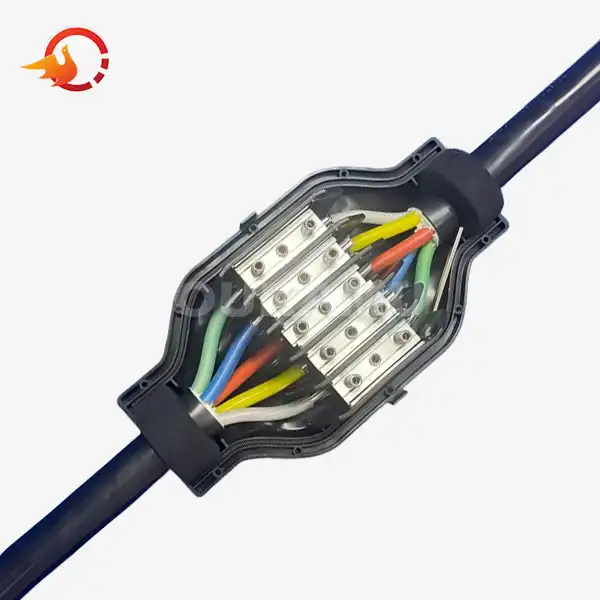
Cable jointing gives cable portions electrical and mechanical continuity. Extending a run, fixing a segment, and tapping a branch from a main wire are common tasks. Straight-through, branch, move, and repair joints are common. A junction in a riser, cable bridge, or distribution corridor must maintain insulation and sealing for years. The conductor connection must carry rated current without excessive heat, and the insulation must meet the cable rating. Thus, the junction design must match cable voltage, size, and structure.
What Cable Termination Does
Terminating a cable prepares it for equipment attachment. It manages insulation, electrical stress, securing, and mechanical support when the conductor exits the cable. Lugs, indoor and outdoor closure kits, stress-control parts, and closing accessories are termination goods. Unlike joints, terminations must fit equipment interfaces, therefore clearances, torque, and lug type important. Termination in low-voltage panel work may be a properly sized lug crimped onto a conductor and fastened to a breaker. Medium voltage terminations add stress-control sections low-voltage operations does not require.
Side-by-Side Comparison
Both occupations have different goals, locations, and parts. The route's cable joints must seal against moisture and replenish insulation. Cable terminations manage equipment interaction and electrical stress at higher voltages. It takes longer to order a joint termination kit or the opposite since the designs and electrical functions vary. I enquire whether the cable continues before quoting a work. Continuous work, with or without a branch, is jointing. Jobs that terminate at a device are termination jobs.
How Cable Jointing and Cable Termination Work
Preparation Steps Both Jobs Share
De-energise the circuit, check it's dead, and correctly measure the cable for both operations in cable jointing. After stripping the outer sheath and insulation per the specifications, installers clean the surfaces and confirm that the kit fits the cable. Joints add connectors and repair insulation. Cable shielding, armour, and earth paths are restored by the joint. Termination adds equipment-specific lug crimping, clearance checks, and torque tightening. Clean work and the correct equipment are as important as the product since moisture, wrong stripping lengths, faulty crimps, and loose bolts may undermine any installation.
Common Technologies: Heat Shrink, Cold Shrink, Resin, and Mechanical
Heat shrink seals after controlled heating. Fire-restricted places benefit from cold shrink products' pre-expanded elastomer parts and no flame. Buried low-voltage wires need watertight enclosures with resin joints. Since resin cure times vary, I always follow the manufacturer's data sheet. Mechanical connections and compression lugs must match conductor material, size, and torque. Untested tape and loose pieces may not provide adequate insulation or environmental protection, therefore a full kit is safer. No approach is universally successful. Site circumstances determine.
How a Branch Joint Changes the Method
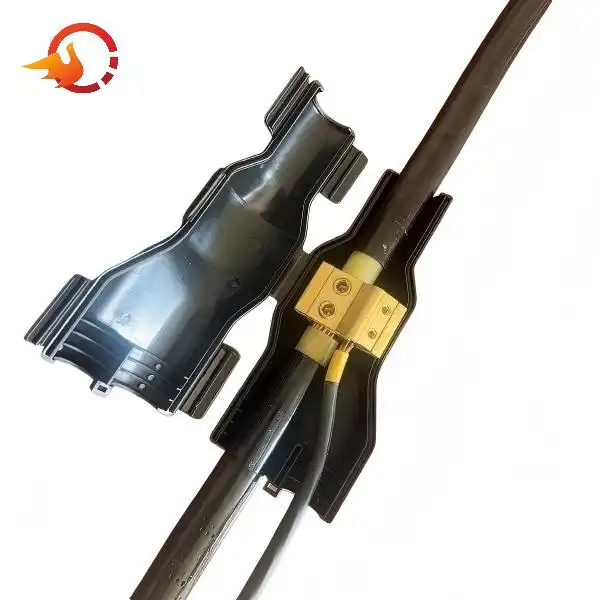
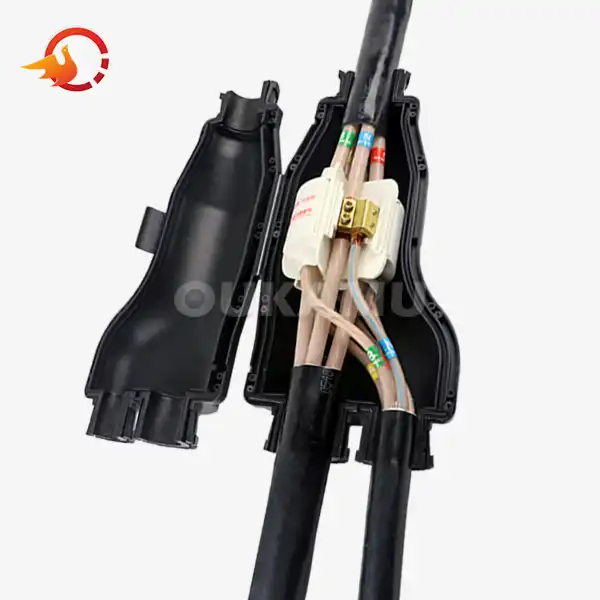
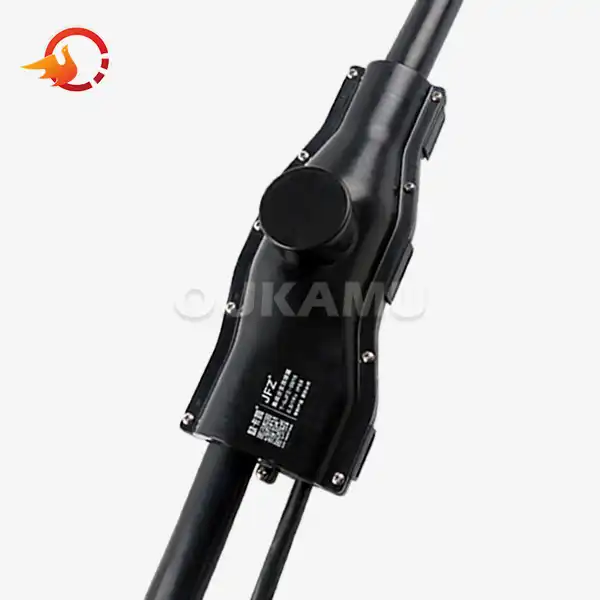
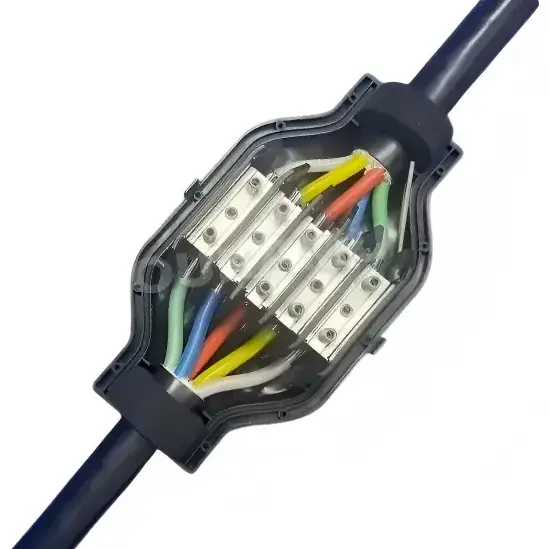
Cutting the main cable, joining both ends, and tapping the branch is typical branch work. A branch cable junction goes another way. It links the main and branch cables on a sealed, flame-retardant, fire-resistant body, preserving the main cable. Oukamu's integrated T-connector works. You build the branch where you need it, so you don't pre-cut the main cable or reserve length. Fewer cut-and-rejoin steps imply less time at each branch point for teams with greater labour expenses. This jointing technique works for cable-to-cable branching, not equipment terminations.
Key Buying Differences: Selecting the Right Product for the Application
Match the Voltage and Cable Construction
Matching conductor size is insufficient. Insulation, stress management, shielding, and testing depend on voltage. IEEE Std 404 addresses medium voltage joints and IEEE Std 48 covers terminations for shielded cables above 2.5 kV. The demands of 0.6/1 kV activities like building distribution are easier. However, the kit must suit the conductor material, insulation type (XLPE or PVC), single-core or multicore construction, and cable diameter. Buyers should provide the cable data sheet with every query so we can verify product dimensions.
Consider the Installation Environment
Environment determines sealing and material. Different dangers exist in panel rooms, cable bridges, risers, burial-only trenches, and outdoor runs. Water, UV, chemicals, temperature fluctuations, vibration, and mechanical stress reduce connection life. Schools, workplaces, and hospitals have fire-performance criteria, thus flame-retardant and resistant to fire insulation is important. Before ordering listed and authorised equipment in the US, check acceptance with the National Electrical Code (NFPA 70) and your local inspector. Instead of picking cable size, ask the provider for application-specific information.

Count Total Installed Cost, Not Only Unit Price
Kit unit prices are just half of the story for cable jointing. The total cost includes labour, tools, wasted cable, lead time, and rework. Cutting the primary cable for a junction reduces the connection length. Oukamu claims their branch junction saves 2–3 meters of main cable, labour, and time. Savings pile up on a level with several branches. Compare bids by unit price, installing hours, cable rescued, delivery time, and documentation. Your electricians may test fit with samples and small trial batches before placing a major purchase.
Oukamu ZR-JFZ-150/50 Branch Joint: Specifications and Fit
Core Specifications
Xi'an Oukamu Electric Co., Ltd. develops, manufactures, and sells cable connection products, with a focus on branch cable connectors. Here are the core specifications of model ZR-JFZ-150/50.
| Item | Specification |
|---|---|
| Model | ZR-JFZ-150/50 |
| Rated voltage | 0.6/1 kV |
| Main cable range | 50–150 mm |
| Branch cable range | 6–50 mm |
| Main cable cutting | Not required |
| Reserved length | Not required |
| Compliance | International safety standards and GB/T 14048.7-2016 |
These figures show that the joint targets low-voltage distribution cable. If your cable falls outside these ranges, tell us. Oukamu also offers OEM service for custom designs and modifications.
Features and Benefits
The next table links each listed feature to what it means on site.
| Feature | What it means for your project |
|---|---|
| No main cable cutting | The main cable stays intact during connection |
| Integrated connection | Main and branch cables connect on a flame-retardant, fire-resistant insulated body |
| Sealed insulation | The branch line is fully insulated and sealed |
| Flexible position | Branch connections can happen at any position |
| Cable saving | Saves 2–3 metres of main cable, plus labor and time |
| Durability | Insulation, flame retardance, fire resistance, waterproofing, dustproofing, anti-aging, and anti-electrochemical corrosion |
The compact body also fits open installation and cable bridges, which saves space where trays are crowded. Making the branch on site also helps when plans change mid-project, because you do not re-order a pre-branched cable.

Example: Branch Taps on a School Wiring Run
A product data-based example follows. Consider a contractor installing 30 branch points from a main wire in a school for cable jointing. The cut-and-rejoin approach requires additional jointing and length for each tap. With the ZR-JFZ-150/50, the team puts each branch where the equipment is and preserves the main cable. If 2–3 meters are saved each tap, 30 taps might save 60–90 meters of main wire before labour. These are planning estimates, not field results. Cable sizes must fit the ranges, and arrangement determines savings. The partnership works for low-voltage cable systems, construction, and industry.
Common Problems, Inspection, and Supplier Selection
Common Failure Causes
Installation or compatibility cause most product failures. Poor sealing, broken jackets, or polluted surfaces let water in. Overheating is caused by loose fasteners, faulty connections, or crimps that increase contact resistance. Void spaces, sharp edges, and improper screen removal may produce partial discharge at medium voltage. Other problems include mismatching kit sizes, combining parts from various systems, and neglecting bending radius. Each joint's documented checklist detects these problems before the inspection.
Inspecting and Testing a Joint or Termination
Inspection begins with a visual inspection of cable preparation, sealing, connection installation, alignment, gaps, and contaminants. Tests may include continuity, durability of the insulation, and ground continuity depending on voltage and project restrictions. Record batch numbers, cable specs, installer name, torque, test results, and photographs. These records accelerate acceptance, verify warranty claims, and aid maintenance. Complete documentation might be as important as the connection on a project that has to go inspection the first time.
Choosing a Supplier and Building Your Checklist
Capable suppliers provide more than prices. Test results, compliance paperwork, installation instructions, sampling availability, delivery schedules, and an invoice are required. Check cable parameters, voltage, conductor sizes, environment, quantity, and delivery location before requesting a price. Since site parameters fluctuate, ask about sample shipping speed and small trial batches. Check OEM alternatives, minimum purchase quantity, and after-sales support. Suppliers that answer these questions clearly frequently solve issues clearly.
Conclusion
Cable termination and cable jointing address distinct issues. Joints connect cable sections and tap major cables, while terminations terminate cable ends at equipment and regulate insulation, tension, and sealing. Selection depends on voltage, cable structure, environment, and local code. Installation, testing, and records determine a connection's durability and inspection. Installed cost—labor, cable length, and delivery time—is a better comparison than unit pricing. ZR-JFZ-150/50 illustrates how a 0.6/1 kV branch junction that leaves the main cable uncut reduces cut-and-rejoin labour and saves 2–3 meters within its cable ranges.
FAQ
What is the best way to joint cables?
It depends on the job. Crimp or mechanical connectors with an insulated, sealed kit suit most low-voltage work. Heat shrink, cold shrink, resin, and branch joints each fit different conditions, so match the method to voltage, cable type, and environment.
Is it OK to join cables?
Yes, when you use a suitable connector and an insulating, sealing kit rated for the cable, and the work meets local code. Twisted wires or tape alone do not meet that standard.
Can a jointing kit work as a termination?
Normally no. Joints and terminations have different designs and electrical functions, so use a termination kit where the cable ends at equipment.
Do I need a license for cable jointing?
Requirements vary by state and jurisdiction. Check with your local authority and follow the manufacturer's instructions.
Request a Cable Jointing Quote from Oukamu
Oukamu is a cable jointing supplier and manufacturer of branch cable joints, including model ZR-JFZ-150/50 for 0.6/1 kV cables. Send us your cable data, quantity, and delivery location at info@okmbranchcable.com, and we will recommend a suitable joint, with sample and OEM options. Our branch joint keeps the main cable intact and saves 2–3 metres of main cable, labor, and time. Visit okmbranchcable.com for details.
References
1. IEEE Std 404, IEEE Standard for Extruded and Laminated Dielectric Shielded Cable Joints Rated 2500 V to 500 000 V, 2012
2. IEEE Std 48, IEEE Standard for Test Procedures and Requirements for Alternating-Current Cable Terminations Used on Shielded Cables, 2009
3. NFPA 70, National Electrical Code, 2023
4. IEC 61238-1-1, Compression and Mechanical Connectors for Power Cables: Test Methods and Requirements for Connectors for Cables up to 36 kV, 2018
5. IEC 60502-1, Power Cables with Extruded Insulation and Their Accessories for Rated Voltages from 1 kV up to 30 kV: Cables for Rated Voltage of 1 kV and 3 kV, 2004
6. GB/T 14048.7, Low-Voltage Switchgear and Controlgear: Ancillary Equipment, Terminal Blocks for Copper Conductors, 2016